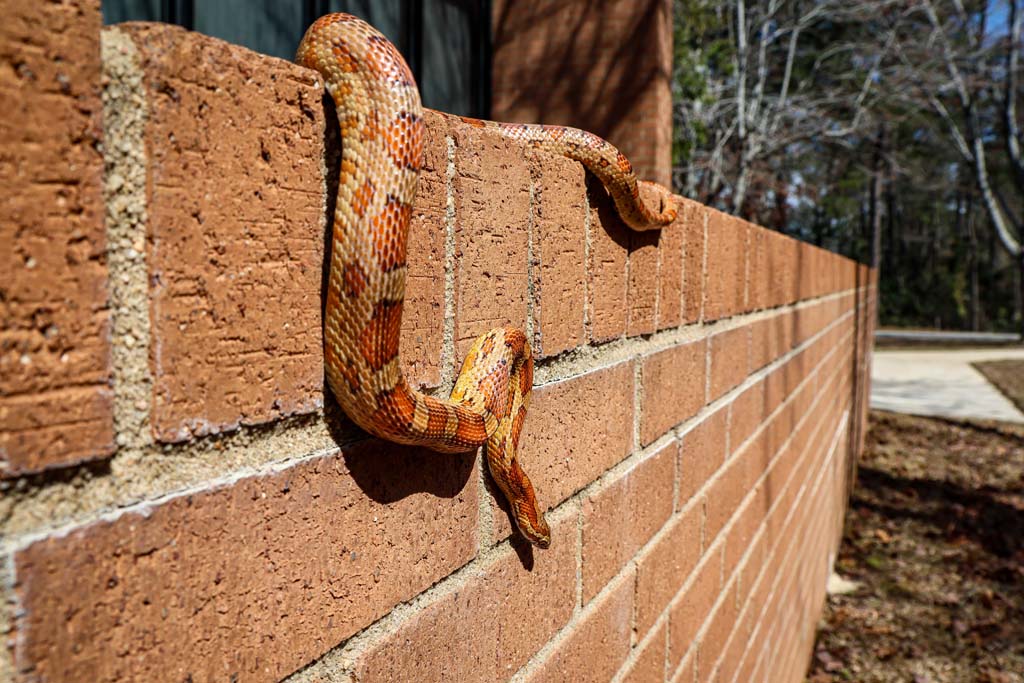
SNAKES ARE COMING OUT ALL OVER
Q. Our porch light is suspended by a chain from the ceiling. Last year, finches built a nest in the light fixture. A ratsnake climbed up the brick walls and got into it. Although I climbed a ladder and poked him with a stick to make him leave the nest, he had already gotten to the baby birds. The finches have returned and are trying to raise a family in the same place. I have read that mothballs might repel snakes. Should I place 5 or 6 mothballs on the porch floor around the perimeter to discourage snakes? The birds do not spend any time at all on the floor. They fly directly into the nest, so hopefully they would not be adversely affected by the mothballs. What about a barrier, like those aluminum cones placed upside down around trees to keep raccoons out of duck boxes?
A. No. I would not recommend any kind of chemical repellent. I have never seen a shred of scientific evidence indicating that mothballs or any of the commercial snake repellents (which most herpetologists consider scams) are effective in deterring snakes outdoors. Individual ratsnakes have been known to return to the same bird nest in subsequent years and eat the eggs or babies of the same mother bird. If you remember the approximate day and month the snake came, you could be on the watch for it. Of course that’s a long shot. Even though you saw the snake in the morning, it might have raided the nest at night.
A barrier to keep a snake from climbing the wall doesn’t sound feasible either. Most predator guards, or baffles, intended to protect eggs in a duck box attached to a pole or a tree are ineffective in deterring large ratsnakes. Climbing snakes are remarkably agile. A ratsnake or corn snake can stretch its body out and then bend back over the shield. All of which means, unfortunately, I can’t recommend any surefire solution. Your best hope lies in knowing that not all ratsnakes return to the same nest each year. Maybe your birds will be luckier this year.
Q. We live in Birmingham, Alabama. Recently we saw a frog on our kitchen window that we would like you to identify. It is light gray on the backside with some darker markings; it almost looks like the bark of an oak tree. We can see its underside through the window. Surprisingly, there is yellow beneath the back legs and it has a little white spot under its eye. What is the frog?
A. Your visitor is a Cope’s gray treefrog. They are usually gray in color, with grainy skin (like tree bark). The groin area is yellow. The squarish white spot you observed beneath the eye is a key characteristic for identification. A note of caution about gray treefrogs. They have toxic secretions on their skin that can irritate your eyes and the mucus membranes of your nose. One night after handling gray treefrogs, I forgot and rubbed my eyes. I had to stop by a stream and splash water in my eyes. If you pick one up, be sure to wash your hands afterward.
In addition to using chemical warfare, gray treefrogs protect themselves with camouflage and flash colors. Although obvious if seen on a clear windowpane, they are virtually invisible when sitting on an oak tree. If a bird sees a gray treefrog and tries to catch it, the frog jumps, flashing its brightly colored underside. When it lands, the color disappears and the frog is once again camouflaged. Meanwhile the bird is looking for a yellow frog. This treefrog has a beautiful call that you might hear day or night high in trees.
NEXT WEEK: Snakes around the house
Send environmental questions to whitgibbons.com/questions.