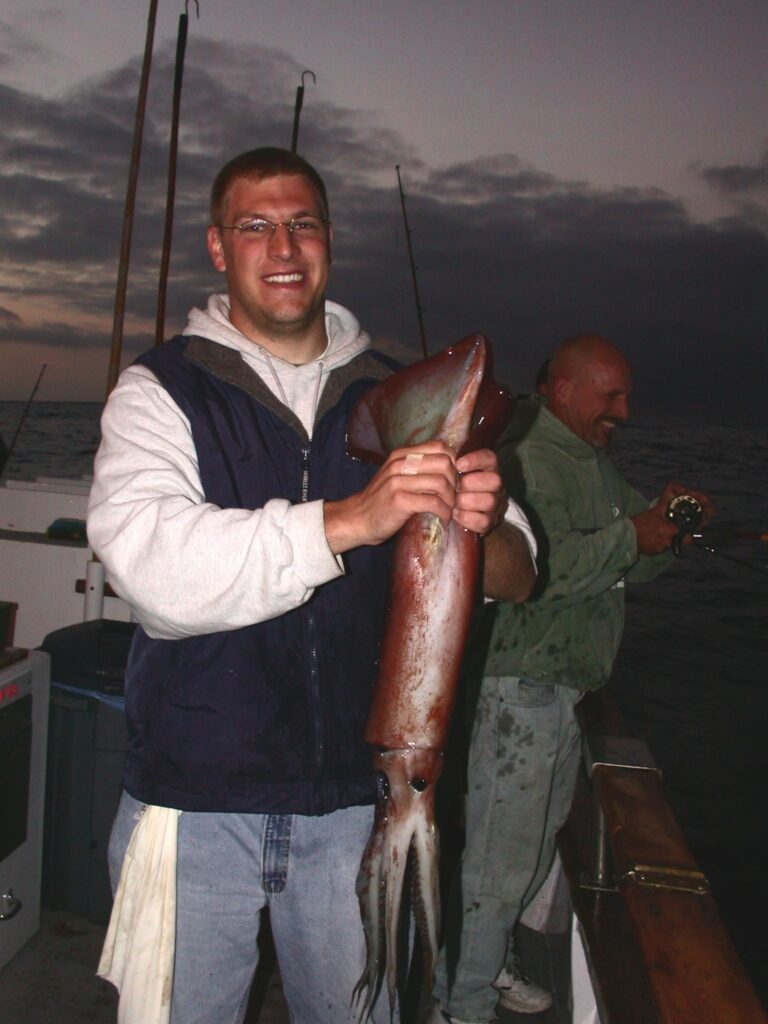
SQUIDS ARE DEEP SEA MYSTERIES
Q. Someone told me that the body and arms of calamari, like you eat in a restaurant, can be more than 40 feet long. I’m not sure I believe my buddy or what I read on the internet, so what are the facts?
A. Calamari are squid. The largest squid on record, reported by the Smithsonian, was 43 feet long (a 7-foot body plus tentacles). Giant squids have huge eyes—the size of volleyballs. Few giant squids have ever been seen alive, even on underwater cameras. Most of what we know is based on huge carcasses washed ashore. Captain Nemo’s encounter with a squad of attacking squids in “Twenty Thousand Leagues under the Sea” does not count as factual reporting.
Humboldt squids, which live in the Pacific Ocean from South America to the U.S. West Coast, also get big (body lengths over 4 feet). These remarkable predators can dive to ocean depths below 2,000 feet, 10 times deeper than most human divers can go. We know more about them than we do about most of the other 500 or so species of squids living in oceans around the world. One reason is that innovative scientists have used technological advances to observe the behavior of Humboldt squids and reveal some of their biological traits. Another is because of their commercial value as “jumbo squid,” which comprise a greater fishery product worldwide than any other invertebrate, including lobsters, shrimp or oysters. The record is more than 800 tons in one year. That’s a lot of calamari.
B.P. Burford (Stanford University) and B.H. Robison (Monterey Bay Aquarium Research Institute) published a paper on Humboldt squids in Proceedings of the National Academy of Sciences. Investigators examined squid behavior and how they communicate in “the largest inhabitable space on the planet.” Deep oceans are difficult to study, and many biological secrets remain to be discovered. It’s dark, very dark where Humboldt squid spend much of their time. Nonetheless, they are social beings displaying group behavior. How do they communicate? The answer is by complex bioluminescent signals, which are all that can be seen in a watery environment with visibility equivalent to the bottom of an ink bottle.
Highly sophisticated underwater videography and analyses allowed the investigators to determine how Humboldt squids convey extensive information to other squids in their squad. They make their whole body luminescent and use their pigment to create various patterns meaningful to other squids. The researchers concluded that “visual signaling is probably crucial” in a deep ocean habitat. It allows them “to coordinate complex schooling behaviors, facilitate collective decisions, and maintain group cohesion.”
In other words, they communicate using light in total darkness. To engage in cooperative hunting would require complex signals. Many underwater denizens use luminescence, but transmitting complicated light signals with different meanings brings communication to a new level. To say they converse with other squids may be overstating their capabilities, but it’s not outlandish. We have underestimated the abilities of animals before. For example, cognitive learning has been documented in the squid’s close relative, the octopus.
The elusive nature of Humboldt squids is underscored by what biologists still do not know about them. Until 2008 scientists had never located a natural egg mass nor hatched the eggs in captivity. The estimated number of eggs was as much as 2 million, a higher reproductive output than any other squid. Also intriguing are reports of Humboldt squids attacking scuba divers, adding to the list of organisms that don’t view humans as special in any way.
The world offers a bewildering array of undiscovered traits among creatures we know exist but whose biology we do not fully understand. Today’s research biologists can conduct complex studies with previously unavailable technology. Humboldt squids send a message about animal behavior and the scientists who study them. The mysterious realm of poorly explored habitats, including the ocean depths, offer endless opportunities to add to our knowledge of the intriguing inhabitants with whom we share the world’s environments.
Send environmental questions to whitgibbons.com/questions