THE LIGHTNER MUSUEM IS FULL OF ECOLOGY
When my sister casually said, “Look at the snake,” I glanced at the woman we were standing beside. Sure enough, a small snake was wrapped around her wrist. We knew the snake was an asp, an Egyptian viper, because the woman was a marble statue of Cleopatra, who purportedly used one to commit suicide. We were in St. Augustine, Florida, at the Lightner Museum, which serves as a testament to Gene Odum’s comment that “ecology is an integral part of our culture.”
To describe the Lightner Museum as eclectic would be spot on. The founder of this singular museum, Otto C. Lightner, was a renowned collector of . . . everything. He founded “Hobbies” magazine in 1931 as the “magazine for collectors.” Lightner had the wherewithal to indulge his taste for collecting, and paintings, statues, antique desks and Tiffany lamps are among the items scattered throughout the museum. Nonetheless, humankind’s connection with the natural environment is so ingrained and deep-rooted that fascination with nature prevailed even in a time of opulence and materialism.
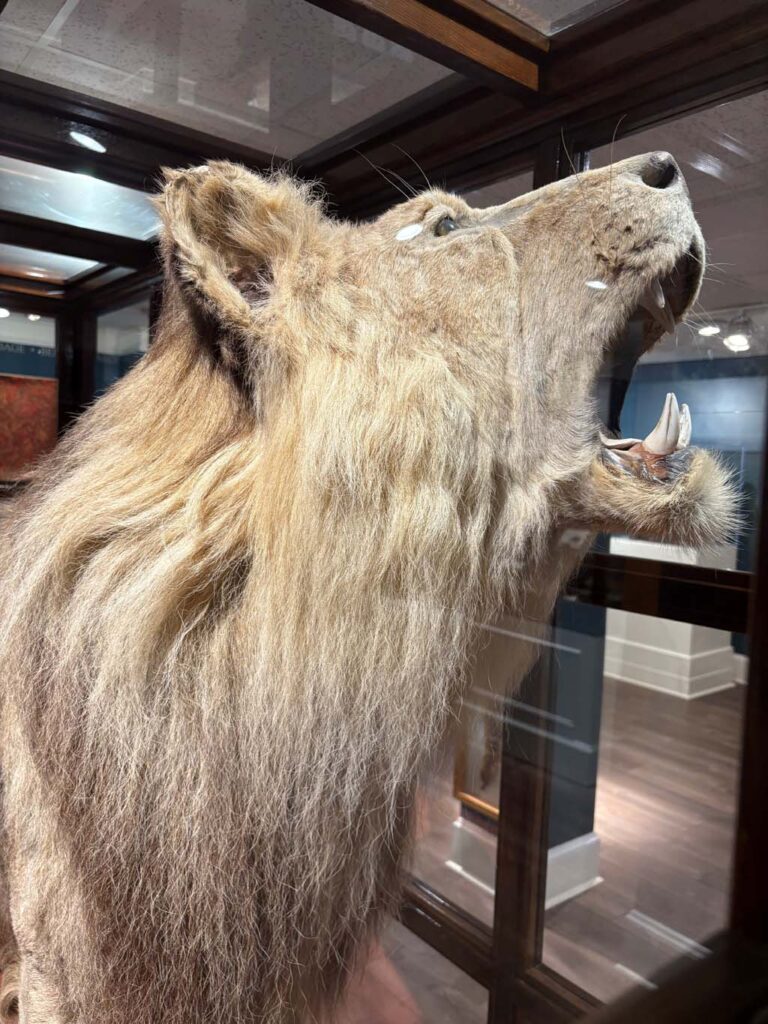
The diversity of biological objects on display, ranging from a dinosaur egg to a miniature cathedral made of fish scales, make this one of the more captivating museums in the world. But unlike most museum exhibits, the Lightner’s do not follow a taxonomic scheme. Unexpected odds and ends can pop up wherever the animals are. Obviously, Otto Lightner had diverse tastes, but why an enormous collage of cigar brand labels, a stuffed snowy owl and a charming train made of painted glass would be only a few feet apart from each other is anyone’s guess. The skin of an enormous eastern diamondback rattlesnake keeps the nature theme going. So too does Rota, the taxidermy lion, which had lived at the London Zoo. In 1943 Rota was designated a “war mascot” by the Zoo and became known as “Churchill’s lion.” The big cat lived until 1955.
Among the biological oddities on display, two center around animals with shells. One is a small but intriguing collection of exquisite mollusk shells. Anyone who has read Oliver Wendell Holmes’s poem “The Chambered Nautilus” will enjoy seeing the stunning shell of one of these iconic cephalopods. Not to be outdone by a mere collection of gorgeous seashells, a South Pacific giant clam shell as big as an automobile tire sits nearby, evoking tales of pearl divers trapped underwater in a vicelike grip. Imagine how inattentive a diver would have to be to be unable to escape from a clam closing its shell at the speed of molasses oozing down the side of a pan.
Unfortunately, the ornate appearance of the shells of many mollusks led to their demise at the hands of humans. The same is true of turtles. The hawksbill sea turtle, whose story offers one of the best examples of the commercial overexploitation of shells, is featured in one of the display cabinets. A shiny example of a hawksbill carapace is surrounded by some of the many tortoise shell ornaments that were popular before the species was listed by the U.S. Fish and Wildlife Service as “endangered, wherever found.” These man-made artifacts include hair combs, a handheld fan and even miniature musical instruments.
The Lightner Museum is an educational adventure in many ways. Once you’ve gotten your fill of animal displays, head for the other floors. There you can admire row after row of antique china plates and gaze upon more crystal than anyone’s grandmother ever dreamed of owning. Whether every man-made item is authentic with regard to its stated origin is questionable. But exhibits of Mother Nature’s creatures pass muster. The biological curiosities in the Lightner Museum are intriguing in and of themselves. Their presence in the midst of a museum devoted primarily to man-made artifacts affirms that the natural world remains an important part of our heritage.
Send environmental questions to ecoviews@gmail.com.