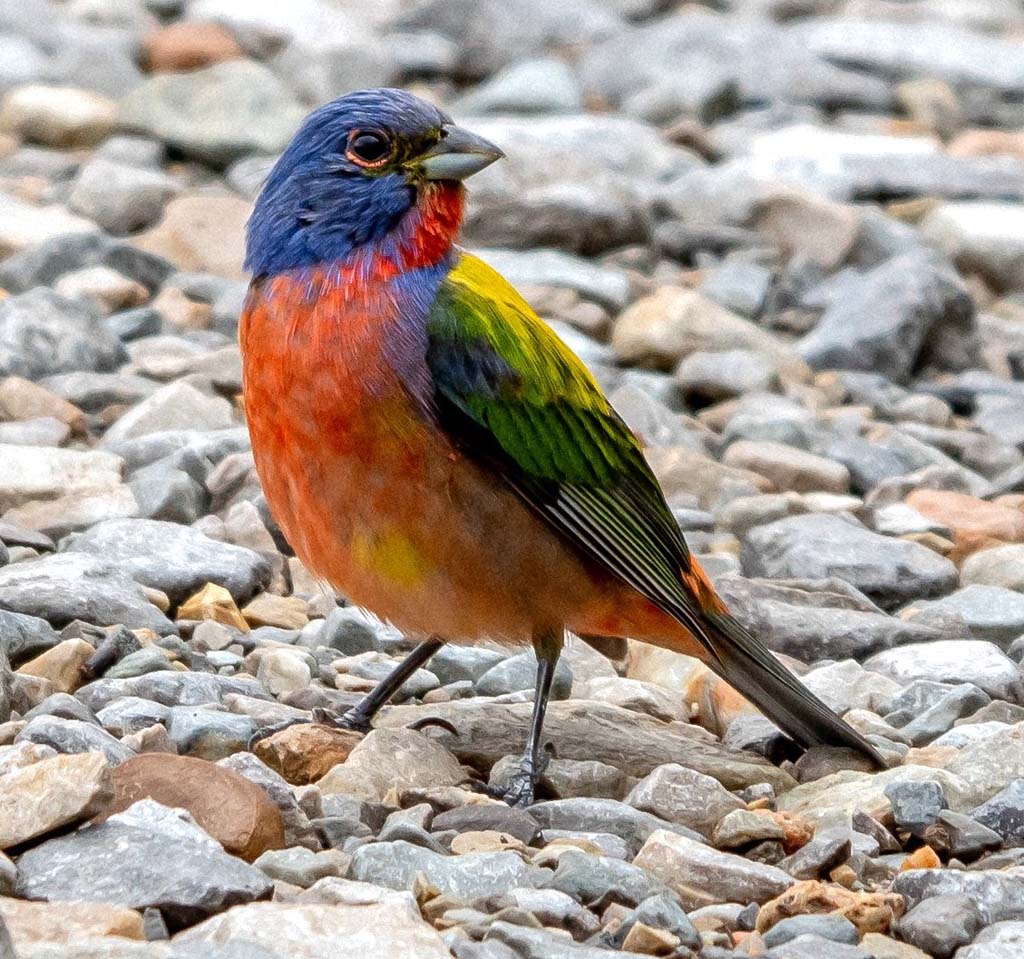
A PRETTY BIRD IS A BETTER BIRD
Ornithologist Peter Stangel points out that male American goldfinches are “neon yellow and jet black when advertising to females, but more modest yellow-green the rest of the year.” He further notes that in some situations “color intensity signals good health to potential mates. A brighter male goldfinch probably has better access to food, which is appealing to a female interested in a mate that will help provide for young.”
Peter’s statement is corroborated by two experiments conducted independently in Europe several years ago and by similar ones since. One finding has been that carotenoids, the pigment that makes carrots orange, may be important for some birds to have. Birds cannot produce carotenoids the way plants do, and they don’t eat carrots. But eating plant material high in carotenoids significantly impacts their mating success.
The orange pigment is responsible for the color of the male’s bill in certain birds that use the brighter color to proclaim “I am fit and will be a worthy mate.” The color of a bird’s bill in this situation is known as a secondary sexual trait, which means it is a feature that distinguishes males from females. Secondary sexual characteristics include the awesome fan of a peacock’s tail being displayed to a peahen. Among fish, the males of a species known as the Alabama darter include orange, turquoise and blue in their courtship display, whereas the females are drabber. Though such traits may seem to be of superficial significance, they can, in fact, be quite important in determining which individuals are more successful in the mating game, that is, which individuals are chosen as mates. Determining why the bird with the brightest orange or red bill is most likely to be successful with females of the species has been something of a mystery.
Researchers in France conducted experiments with a type of blackbird in which males with higher carotenoid levels have brighter orange bills. These males are the most likely to become paired with females that are in the best physical condition. The scientists also determined that carotenoids are used in immune responses, helping to fight disease and infection. They concluded that the signal of bill color is indeed an indicator of an individual blackbird’s health.
Similar conclusions were reached in Scotland in laboratory experiments conducted with zebra finches. The investigators took 10 pairs of males that were brothers. They fed one of each pair water with carotenoids and gave the other one distilled water. As anticipated, the bills of birds receiving the carotenoids turned significantly redder than those of the controls.
The next part of the test was to determine if a brighter bill had any measurable effect on mating success. Sure enough, female zebra finches spent significantly more time perched next to the males with brighter bills, indicating a preference for them. The next step, duplicating an experiment that had also been done with the blackbirds, involved injecting the finches with a foreign substance that causes an immune response in birds, the way a virus or bacteria might. The carotenoid-supplemented and control males received the same doses.
All birds responded to the foreign substance in the body, but the carotenoid-supplemented birds exhibited a type of immune response that has been shown to result in higher survival rates. The significant finding of the two studies is that seemingly trivial, even frivolous, secondary sexual traits used by females in deciding which mate to choose can be true indicators of health and, therefore, presumably higher fitness of males.
Next time you have cardinals around your yard, notice whether some of the males have brighter red bills than the others. Try to determine if these birds are the dominant ones that the females seem to prefer. And don’t forget to eat your carrots.
Send environmental questions to whitgibbons.com/questions.