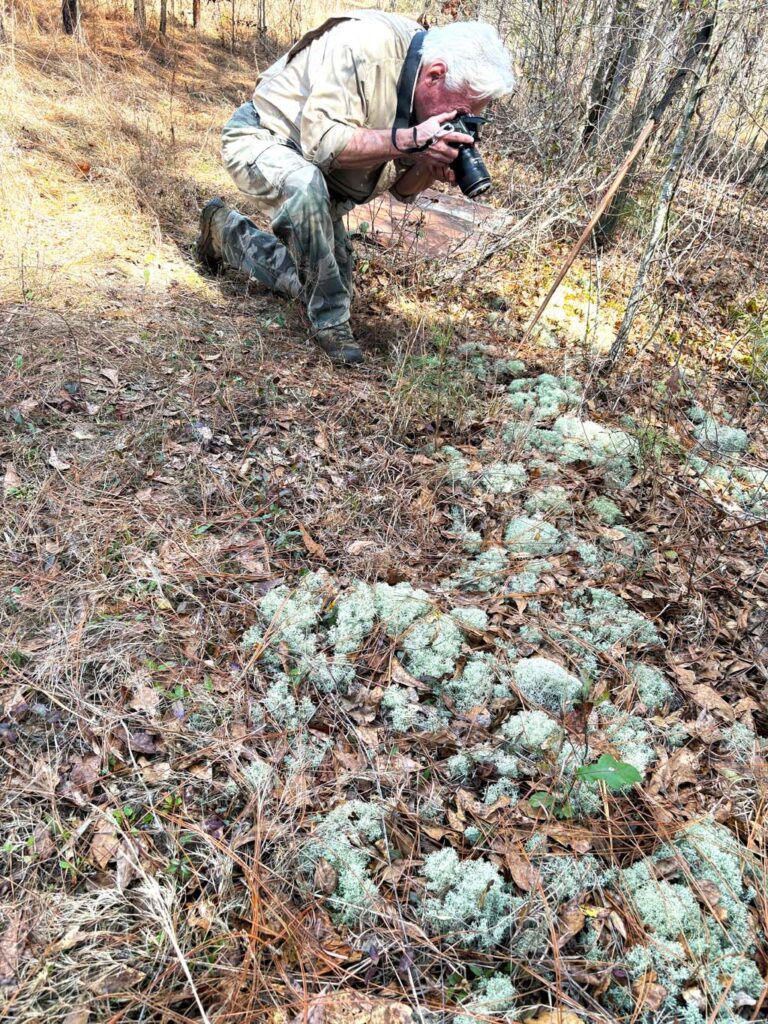
LICHENS ARE ALL OVER THE WORLD
What am I going to do with these kids, I wondered. I had agreed to oversee an after-hours science club at a local elementary school to teach a bunch of third-graders about ecology. I had been looking forward to what I thought would be a simultaneously challenging and gratifying experience. The problem: it was raining.
On this first day I had planned to take the science club outside to see what living plants or animals we could find associated with trees in the schoolyard. But with a day that turned out to be not only rainy but also cold and windy, I would need an indoor exercise. Then the answer occurred to me. An ubiquitous form of life was within reach. I grabbed my raincoat, went outside and within minutes picked up 20 small limbs that held the answer to my dilemma: lichens.
Although lichens look like a single organism, they actually represent a complex relationship between fungi and algae. And they can grow virtually anywhere. Third-graders make ideal students. They don’t yet have in-depth knowledge about any topic, including science, and have nothing to unlearn. What they have in abundance are curiosity and unfettered imaginations, which lead to open-minded thinking. Lichens easily became the day’s science topic.
I asked the students if they knew what scientists who study lichens are called. Up went a hand. “Lichenologists.” I was a bit surprised and asked how he knew that. “I didn’t really know,” he said. “I just guessed. Someone who studies science is a scientist, and someone who studies biology is a biologist. I assumed they had to be ‘ists’ of some sort.” Pretty impressive for a third-grader. Were it not for a love of learning instilled by some teachers, we might not have anyone who wants to learn enough about a topic to become an “ist.” Turns out the kids learned to love lichens that day, and I would not be surprised if one of them becomes a lichenologist, probably the one who had this query: “Why don’t more biologists become lichenologists?” Good question.
For the indoor session with lichens, I had plenty of sticks to go around so everybody had one or more to look at up close. I told them we were going to be like biologists and ask some basic questions about lichens that any scientist might ask—who, what, why, where, when, and how? They had already answered the “who studies lichens” question, and hands shot up immediately when I invited them to ask others. Someone asked, “Where do lichens live?” From the Arctic to deserts to cities, they can be found on trees and other flat surfaces all over the world. In some regions of Arctic tundra, a carpet of reindeer moss, a type of lichen, provides the major source of food and nutrients for caribou, which in turn are a primary food source for wolves. Odd to think that such an awesome predator ultimately depends on a combination of a fungus and algae for its survival.
“When do they grow?” Year round. Their ubiquity and constancy make lichens ideal organisms to show students in a classroom: anyone teaching science can always find plenty. “How do they get their food?” Lichens are composed of algae, which has chlorophyll that converts energy from the sun. “What colors are they?” The children answered that themselves as they pointed out lichens and other fungi on the limbs. They found red, gray, green, white, black, yellow, blue and purple. The colorful lichens fascinated the students—as well as me. Seeing through the eyes of children . . .
The lesson about lichens proved to be entertaining and instructive for teacher and students alike. You need not be a parent, child or teacher to see how many lichens you can find in your neighborhood. Get outside on your own. Discover new ways to see the world.
Send environmental questions to whitgibbons.com/questions.