WHAT SNAKES LIVE AROUND YOUR HOUSE?
Following are questions readers have asked about snakes in and around the house. They sometimes send photos to help with identification.
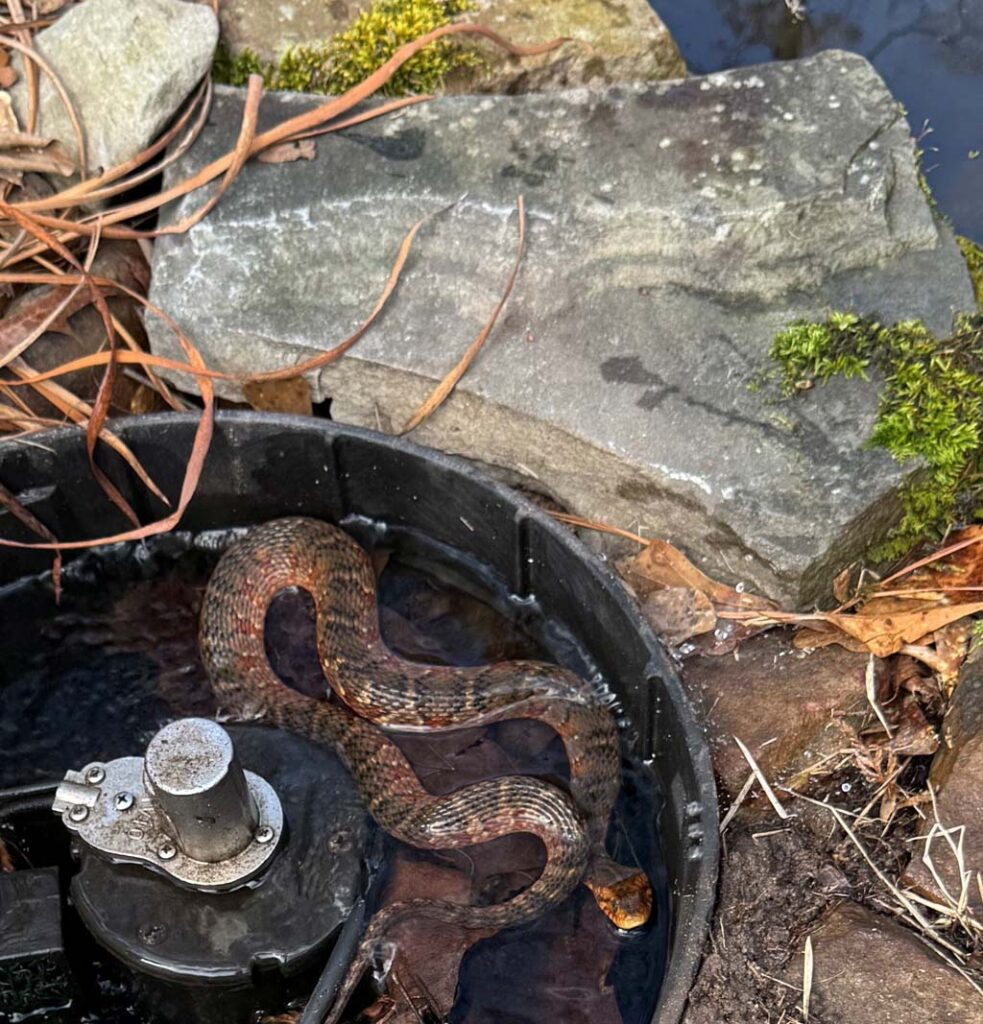
Q. We’ve been trying to clean out the weir of our freshwater, man-made pond in South Carolina but this snake refuses to leave. Can you tell from the photo if it’s a copperhead or a less dangerous water snake, and how can we discourage it from habitation here (we no longer have any frogs)?.
A. That is a southern banded watersnake. They are nonvenomous but will bite if you pick them up. He may have eaten a frog or two, but my guess is that the frogs left on their own (maybe because the snake was there). I am impressed it let you get that close for such a cool photo. It will probably just leave eventually. Meanwhile, it can serve as a showpiece for guests, especially if they are in awe of snakes.
Q. I live in Tuscaloosa, Alabama. While working in my garden, I saw a small, pencil-size brown snake with a lighter brown stripe down its back. I have seen them before and all have been little snakes, never more than a few inches long. My neighbor says they are copperheads because of the brown color, but that’s probably not true because they have no crossbands and are not as heavy-bodied as I think a copperhead would be.
A. That is a DeKay’s brown snake, a great snake to find on a walk in the woods, in your garden or even in your swimming pool skimmer. They are called DeKay’s brown snake in honor of a 19th-century herpetologist. They can vary a bit in body pattern, such as having spots or a midbody stripe, but they are always brown in color. The largest one ever found was only slightly over a foot in length. A copperhead that small would typically have a bright yellow tail and, as you noted, would have a banding pattern.
DeKay’s snakes are one of the most inoffensive snakes in the country. They are completely harmless, even to pets. I have never heard of one biting a person. The only thing I have ever seen them bite is an earthworm before eating it. If you have a garden or ornamental plants, you certainly want to have these little snakes around. Slugs are their favorite food, and they eat a lot of them.
Q. I live in Atlanta and found a snake in my house! The disturbing part is that it was in an upstairs bedroom where I had accidentally left the windows open after removing the screens a couple of days ago with plans to clean them. The snake was on the floor and actually reared back and kept striking at me. I didn’t want to kill it, and it was small enough that I was able to pick it up with a broom and dustpan and pitch it out the window. But how could it have climbed up so high? It was gray with darker gray blotches (see photo). Was it a venomous snake?
A. I have not heard of any U.S. venomous snake (copperhead, rattlesnake or cottonmouth) climbing up into the second story of a house. Yours is a young ratsnake. It climbed up ivy or bricks, probably searching for a bird’s nest with eggs. Ratsnakes will even crawl through ventilation slats in an attic to eat flying squirrels, bats or rats.
Q. I am from Montgomery and have put up a couple of bluebird boxes in hopes of watching them raise some young. I saw this snake (see photo) disappear into some bushes. Is it a threat to bluebirds?
A. That is a ratsnake, so the simple answer is yes. It might eat bluebird eggs or babies, but it will probably get rid of any rodents it finds as well.
Send environmental questions to whitgibbons.com/questions.