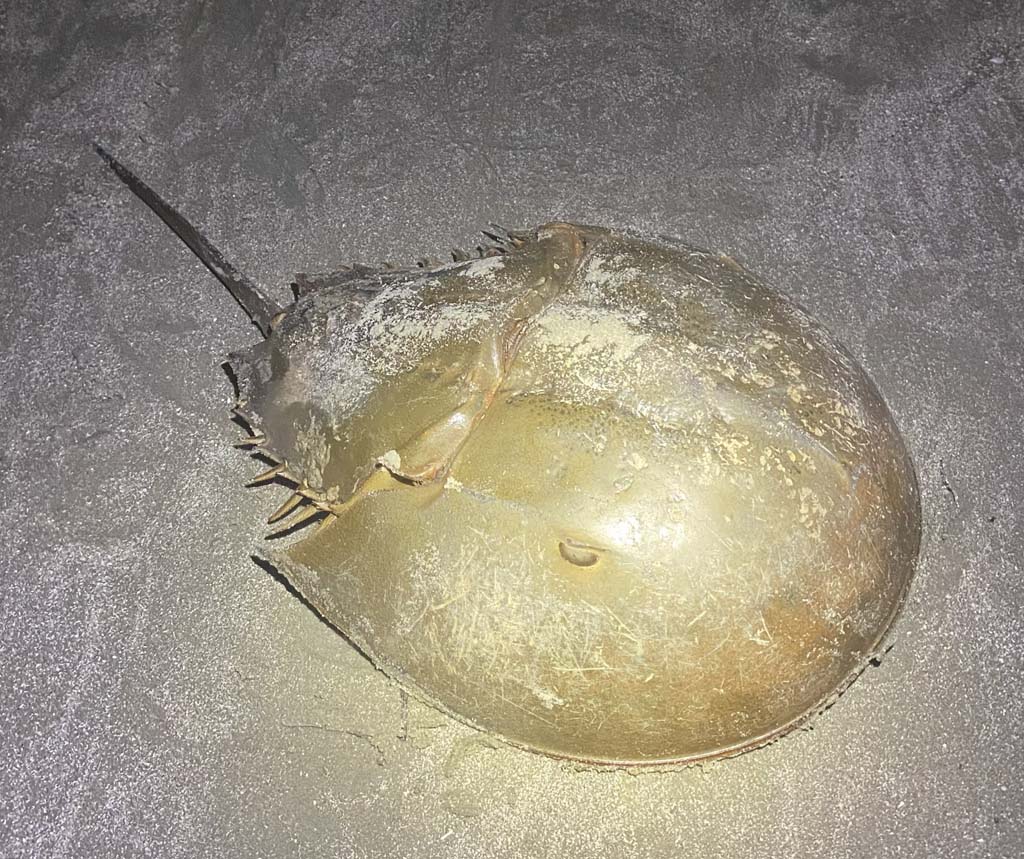
HORSESHOE CRABS LOOK FIERCE BUT ARE HARMLESS
Two animal mysteries associated with coastlines intrigue me. Who ate the first raw oyster? Who picked up the first horseshoe crab?
The first person who pried open what looks like a rough gray rock and scooped out the gooey insides must have been starving. Whoever threw caution to the wind and first picked up a dinner-plate-size creature with a long tail that looks like a stinger and legs like hairy pincers was brave or foolish or both.
An adult horseshoe crab is, without question, a formidable-looking creature. Gazing down at one on a beach, you see what looks like a flat olive-colored helmet with knobs and ridges on the top and a smaller helmet in the back with rows of jagged spikes on the margins. They use the rigid body-length tail, which resembles the venomous barbed tail of a stingray but is completely harmless, to right themselves when tossed by the surf. On the underside of a horseshoe crab 10 long black legs have pincers at the ends. Although horseshoe crabs look fierce, they do not sting, pinch or bite people. They are more closely related to scorpions than to crabs. Turns out the first person to pick one up was in no danger. Adding to the overall weirdness of horseshoe crabs, their blood is blue.
These bizarre animals, which belong to a group distinct from the more familiar crustaceans such as blue crabs, shrimp and lobsters, were swimming in the ancient seas of the Jurassic period when dinosaurs lived on earth. But their ancestry is much older than the dinosaurs, which disappeared about 63 million years ago. The earliest horseshoe crab fossils are almost 500,000 million years old. Unfortunately, as with many kinds of wildlife that have persisted for countless years in a natural world, horseshoe crabs in some regions are considered to be in serious trouble environmentally.
One issue is habitat degradation along the coastlines of America and the rest of the world. Another is overharvesting. A few decades ago, millions of horseshoe crabs were removed along the Atlantic Coast to make fertilizer. Today one of the threats is removal by pharmaceutical companies because the blue blood of horseshoe crabs has special properties that immobilize bacteria. With proper experiments in biochemical laboratories, such properties could result in unprecedented medical advances. Although research facilities return some of the animals to the sea, their life cycle has been disrupted. The full impact on horseshoe crab populations has not yet been determined.
As so often happens, when one species is in peril others are also at risk. The red knot is a bird species of conservation concern. Flocks of red knots gather along the mid-Atlantic Coast during migration to feed on horseshoe crab larvae. Some conservation groups have determined that the overharvesting of horseshoe crabs is limiting the natural food of the migrating shorebirds. Red knots migrate more than 9,000 miles each year, from the Arctic to the southern tip of South America and back; they need all the fuel they can get along the way. The decline of a major prey item does not help.
Fortunately, areas still exist where thousands of horseshoe crabs move into coastal waters for natural seasonal nesting events with high predictability. Meg Hoyle of Botany Bay Ecotours recounts an experience near Charleston, South Carolina, during a full moon in April. “I was walking along the beach and had to stop because there were so many horseshoe crabs, there was no place to walk without stepping on them!” Imagine that with every step you took you trod on a big china plate that cracked underfoot.
Like many other coastal invertebrates, a single horseshoe crab can release thousands of fertilized eggs to replenish their population. Let’s hope they continue to do so and that all the babies grow up to be adult horseshoe crabs, one of the most peculiar of the earth’s benign creatures.
Send environmental questions to whitgibbons.com/questions.