WERE THE ORIGINAL MERMAIDS MANATEES?
Christopher Columbus gets credit for the first written record of manatees in North America, ones he saw near the Dominican Republic in 1492. West Indian manatees, also called Florida manatees, are resident in peninsular Florida; they occur in the Caribbean and along the Gulf Coast to Mexico. During summer, some wander as far north as Virginia and have even been reported from Massachusetts.
This group of solely aquatic mammals, known scientifically as the Sirenia, is unrelated to whales and dolphins. The scientific name comes from the sirens, the mythical sea nymphs who lured lovesick sailors to watery graves. Some historians believe that sailors reporting mermaid sightings actually saw manatees. They have no hind legs and do have a flipperlike tail vaguely resembling a mermaid’s. But they also have a blimp-shaped body and a pair of paddles for front legs. A sailor must have been at sea a long time to mistake a “sea cow” for anything resembling a beautiful woman with flowing tresses.
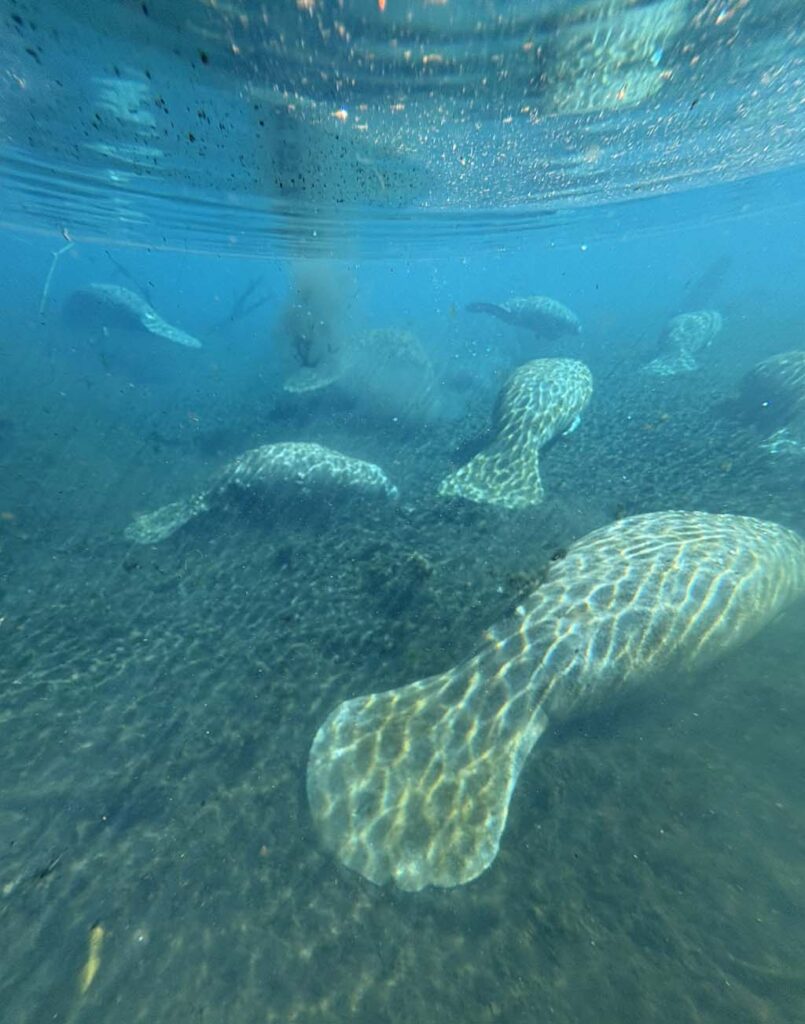
Manatees are so ugly they are cute, with a piglike face, small, widely set eyes, and a blubbery upper lip. Two-inch-thick skin is covered with sparse, bristly hair. An average adult is almost 10 feet long. Really big ones can be over 12 feet and weigh more than half a ton. One way manatees communicate is by touching muzzles. People who have had the good fortune to swim with these gentle giants discover that manatees will playfully nibble a swimmer with their rubbery lips. These days kissing a manatee, or even touching one, is forbidden by federal and state laws.
Female manatees normally give birth to a single young that looks like a miniature adult and weighs 60 pounds. Like other marine mammals, which have no gills and must breathe air, a mother manatee’s first job is to make sure the baby starts breathing properly. Manatees can remain submerged for 5 to 10 minutes, so the newborn is taught to surface and sink in a rhythmic pattern. Carrying the baby on her back, the mother rises for a breath and then sinks, until the baby learns to breathe alone. The young remain with their mother for about 2 years. Nourishment during the first few months comes mostly from mother’s milk.
Manatees, which are not restricted to saltwater, spend much of their life wandering up rivers. In winter they remain in areas where temperatures stay warm. Pneumonia and other illnesses following cold spells are commonly reported natural causes of death. Manatees are strict vegetarians and, despite their size, are harmless to other animals, including humans. No animals routinely prey on manatees so, not surprisingly, humans pose the greatest threat to their survival. These benign, nonaggressive leviathans lack adequate defense against intentional or accidental harm.
Ironically, one of the biggest problems faced by manatees today stems from people’s interest in them. These big, gentle beasts will solicit a back or belly rub, something they seem to enjoy immensely, but it is now illegal. Swimmers can disrupt their feeding or drive them from their resting places. A few folks living in coastal areas want to feed them or give them freshwater if they are in a saltwater habitat. Both actions are illegal.
Among the biggest human threats to manatees are motorboat propellers, which injure many manatees every year. Most of Florida’s manatees are believed to have scars from boat injuries. As many as 60 have been killed by boats in a single year. Unfortunately, these curious creatures do not avoid—and are sometimes even attracted to—boats. Malicious behavior toward these inoffensive animals is condemned by wildlife officials.
Many boat operators want no restrictions on where or how fast they travel. Perhaps the solution lies in establishing a program to require boat drivers to swim with manatees. Surely, anyone who has swum with a manatee would advocate protecting these marvelous creatures, even if that meant restrictions on certain boating activities.
Send environmental questions to ecoviews@gmail.com.