WHAT SHOULD WE DO ABOUT SHREWS AND MOLES IN OUR YARDS?
Q. I have been unsuccessful in getting a satisfactory answer about how destructive shrews and moles might be to my lawn and garden. What should I do about them?
A. My response to the discovery of either one of these creatures in my yard is to do nothing. I like having both around. Also, shrews and moles are very different kinds of animals biologically, so it is possible to like one and not the other. Internet hype overstates what I consider to be insignificant problems caused by shrews. Meanwhile, many homeowners, backyard gardeners and golf course groundskeepers take issue with moles. The reasons for objecting can vary. Some people may object to their superficial modification of the terrain or root damage to plants and consider that sufficient rationale for removing moles.
More than a half dozen kinds of moles are found in North America, from Canada to Mexico. Their primary diet consists of insects, including underground larvae and pupae. The most familiar and geographically wide-ranging species, which some people consider to be a nuisance, is the eastern mole. These burrow across lawns, golf courses and gardens. Eastern moles are the size of big mice; they have tiny eyes and enormous, web-shaped front feet designed for subterranean digging. As they travel beneath a grassy surface, they leave a mound of raised dirt above their tunnel. A mole’s highway system is seldom appreciated by someone with a perfectly manicured lawn or a golfer putting on a green. I have puzzled about one aspect of a mole’s tunneling. When a mole crosses a dirt road, its path to the opposite side is usually perpendicular to the road. How does it know the shortest route when it cannot see the other side?
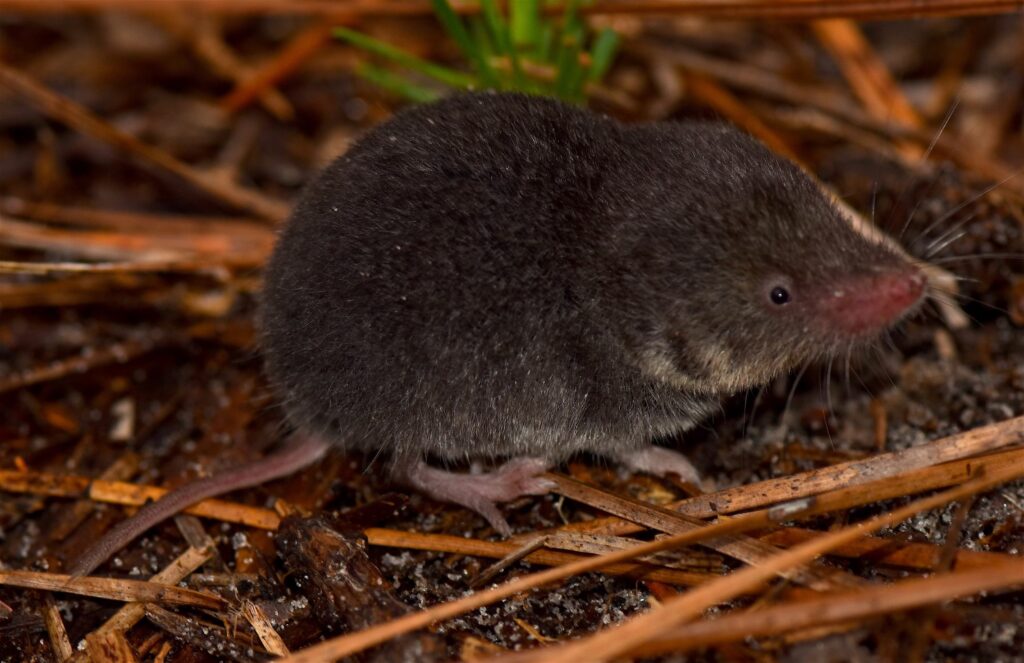
Shrews are tiny, secretive mammals. Though absent from Australia and Antarctica, the total number of species on other continents approaches 400. About a dozen are in the eastern United States. Shrews are well adapted for cold climates. Vermont has 8 species and Alaska 10, compared to Alabama’s 6 and Florida’s 3. Shrews are distinctive in many ways. The short-tailed shrew of the eastern United States is one of the few venomous mammals in the world. The shrew’s saliva, produced by glands in the mouth, is forced into prey by biting and can paralyze earthworms and small snakes. The 2-inch-long pygmy shrew found from southern Canada to northern Alabama is one of the smallest mammals in the world. Some adult shrews weigh less than a nickel.
A major problem confronting these small, warm-blooded predators is an exceedingly high metabolic rate, among the highest vertebrate metabolisms in the world. Shrews have a voracious appetite and must eat constantly or die. Shrews kept in captivity have been observed to eat more than their own weight each day. When trapped at night for scientific purposes, shrews will starve to death before morning if no food is left in the trap.
They are constantly on the move in search of prey. Their primary food is insects, including grubs and other larvae, spiders, slugs and earthworms They will not hesitate to eat small mice, amphibians or reptiles, especially those found in a dormant state during winter. Sometimes they eat fungi and vegetation. But even in the coldest climates, shrews do not hibernate. How they survive a northern winter beneath snow, finding an adequate supply of food to fuel themselves and staying alive until spring is perplexing. I see no valid reason to try to remove such an intriguing animal from my yard.
Shrews and moles are fascinating and pose no health hazard for humans. Aside from special situations in which mole damage is likely to create a serious cosmetic or horticultural problem, I see no reason to try to eliminate moles or shrews from your yard. A better approach for most of us is to enjoy them as part of our natural fauna.
Send environmental questions to whitgibbons.com/questions.