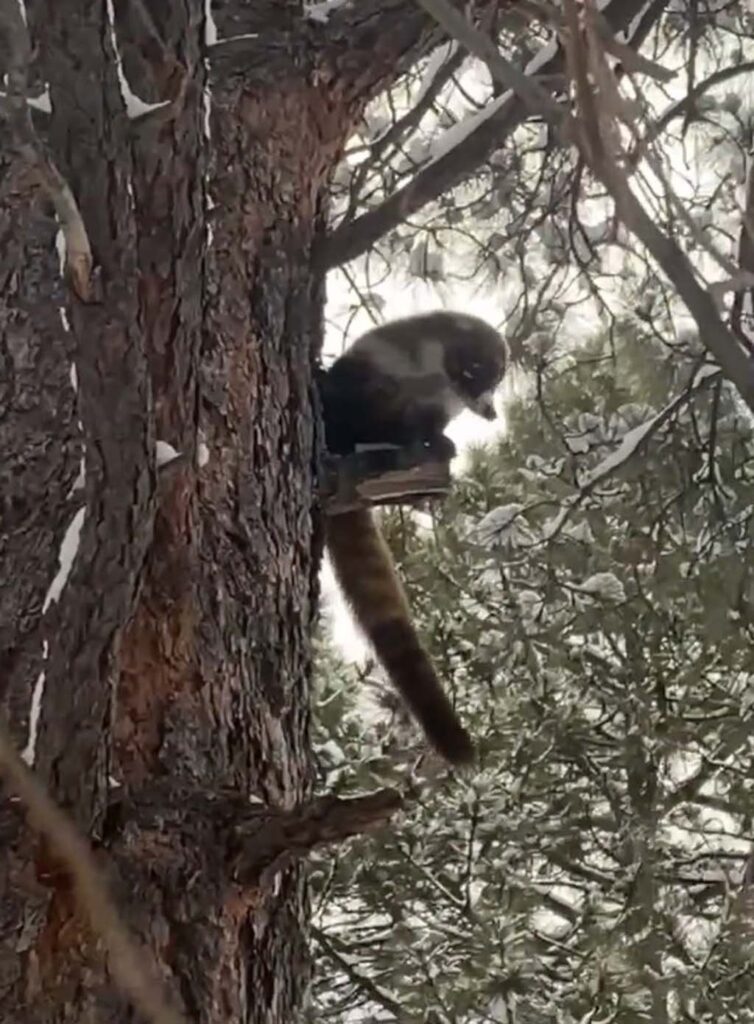
ARE COATIMUNDIS MOVING NORTH?
Q. I have heard that some kinds of wild animals in North America are moving north out of their native range because of global warming. Are there examples of animals traveling northward?
A. Quick answer: yes, armadillos as a species, not just a few individuals, have expanded their range north from Florida. A long ways north. So has at least one coatimundi, a mammal with a vast natural geographic range, from southwestern deserts to South America. A coatimundi was sighted a few years ago in Flagstaff, Arizona, more than 200 miles north of its normal range near the Mexican border. A wildlife biologist in the region attributed one possibility for the range extension to climate change, which allowed the species to move into formerly unsuitable habitat. Whether global warming, aka climate change, has played a major or partial role in dispersal of armadillos or coatimundis is equivocal.
Coatimundis are agile, tree-climbing carnivores in the same family as raccoons. Like raccoons, they are charismatic, and they are mischievous creatures when they share an area with humans. A ring-tailed coati looks like a slender version of its more robust cousin. Another difference is that raccoons are mostly nocturnal whereas coatis often travel during the day. Raccoons are normally solitary creatures operating independently. They may congregate around a food source (I once counted 20 around a rtestaurant’s dumpster), and juveniles in a litter follow their mother around for a few weeks. Coatimundis travel in groups, called troops or bands, composed of adult females and juveniles of both sexes. When a male reaches maturity, it becomes “coati non grata” and leaves the traveling troop. The rest stick together.
The ecological success of coatis is underscored by their ability to live in a variety of habitats from deserts on the southern border of the U.S. to tropical rainforests in Brazil and farther south. Among biological explanations for their ubiquity are an omnivorous diet of plants and fruits, supplemented with insects and other invertebrates. An occasional small lizard or frog might supplement the diet. The roaming nature of coati troops could lead to an increase in their range.
Climate change may affect northward expansion for some species. But range expansion can also occur naturally, making cause and effect relationships difficult to sort out. Nine-banded armadillos have been moving north for decades if not centuries. Armadillos belong to a distinctive family of insect-eating mammals. Most of the 20 or so species live in Central and South America, but nine-banded armadillos are native to the United States. Over the past 40 years, they have been documented moving gradually north from Florida into Alabama and Georgia.
Armadillos started trekking northward from South America long ago and by the 1950s or earlier were common in Louisiana and Texas. Although details on the “how” are hazy, armadillos were eventually introduced into southern Florida, where they were frequently seen lying dead on the road in the 1960s. By the 1990s armadillos had moved north of the Florida panhandle. One biologist noted that “armadillos crossed I-20 going north in 1995.” I would note that some crossed; others did not even make it to the median. Armadillos compete with possums in the road-kill Olympics. Nonetheless, they have expanded their range to include Missouri, Iowa and Illinois.
Gradual increases in environmental temperatures are certainly not the sole cause of armadillo excursions into northern climates and may not be for coatis either. Many animals move overland and simply end up in new regions where they have no competition, no new predators and where they can find the food they need. Armadillos inhabit burrows they dig, which means a slight change in air temperature poses no problem. Coatis climb trees, so their ecology is much different, but one thing is certain. Explanations for animal distribution patterns are highly complex. Why some are successful migrants and others are not often has no simple answer, and why they do it has myriad explanations.