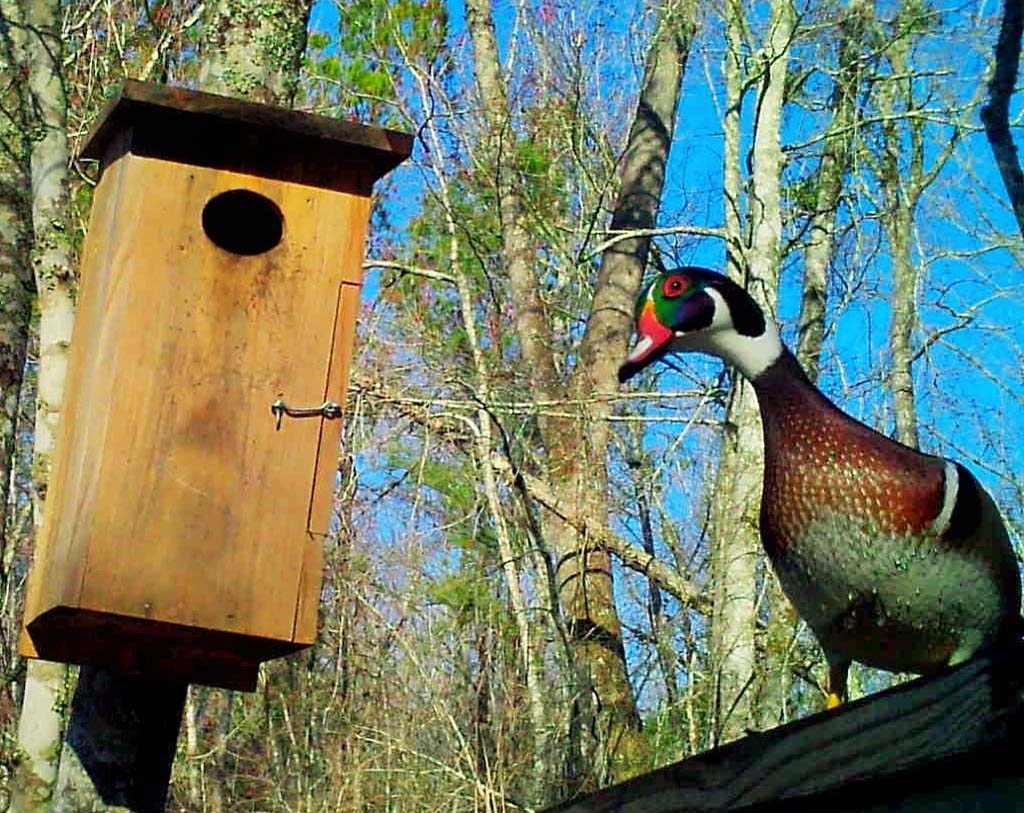
WHAT ARE THOSE METAL CONES BELOW DUCK BOXES?
Q. What kind of ducks lay eggs in the boxes I see on trees and poles around lakes and reservoirs? And what is the purpose of the large silver-colored cones installed between the nesting box and the ground or water?
A. Cavity-nesting ducks use the boxes. The most common ones native to the Southeast are wood ducks, which nest from late winter through spring. A female typically lays a dozen or more eggs during a nesting bout. The cones you refer to, called predator guards, are made of galvanized sheet metal. They are intended to prevent raccoons, possums and bobcats from climbing up and eating the eggs of a nesting female or even making a meal of the female herself. The effectiveness of the guard varies with the type of predator, being most effective at preventing tree-climbing mammals from reaching the nest.
Because ratsnakes are agile climbers, big ones can often get around the cones. A wood duck nest protected with a predator guard is also ineffective if a ratsnake stretches itself out from a nearby tree to reach the top of the post the box is on. It can then dine on duck eggs. In addition to not deterring big ratsnakes, predator guards do not protect from flying squirrels, which also enjoy duck eggs. In such instances, predator guards are worthless.
Bobby Kennamer, a friend and colleague at the University of Georgia’s Savannah River Ecology Lab, has conducted impressive long term ecological studies on wood ducks. He and his fellow researchers tagged ducks for over 30 years and encountered more than 50,000 eggs. According to Bobby, studies have documented that wood ducks using boxes with predator guards have greater nesting success than those without such protection. This is satisfying to hunters whose goal is to boost wood duck populations to promote renewal of that natural resource. Another school of thought, however, maintains that when duck boxes are not protected from predators, they more closely replicate the natural world and thus promote the adaptations and fitness of every species in this predator-prey relationship. Not all conservation biologists agree that predator guards are a good idea, although most duck hunters probably do.
Q. Everyone seems to want to know how to attract hummingbirds to their yard. What I want to know is can they open their beaks? Where is the mouth located? Do they suck up nectar and sugar water like a straw?
A. A hummingbird’s long, narrow beak opens along its entire length, reminiscent of a pair of needle-nose pliers. Like other birds, its open beak is its mouth. As hummingbirds consume tree sap, lichens and small insects, being able to open the mouth is essential. The beak also acts like a sheath for the hummingbird’s long, protrusible tongue, which can extend beyond the beak’s tip. When the tongue is fully extended, the length can be almost double that from the base of the beak to the end.
As recently as a couple of decades ago, hummingbird beaks were thought to function like a straw, drawing up nectar by capillary action. A study of several species of hummingbirds by Alejandro Rico-Guevara and Margaret A. Rubega (University of Connecticut) published in the Proceedings of the National Academy of Sciences discovered the mechanism of the bird’s fluid uptake. The tip of the tongue is forked and has tiny brushlike extensions on the sides. The trapping of liquid is mechanical when the bird closes the tip and withdraws its tongue. One of the surprises in the initial study was that even a dead hummingbird could capture liquid when the researchers physically closed and retracted the tongue. The beak and tongue of a ruby-throated hummingbird, the most prevalent kind in the eastern states, permit the tiny bird to reach deep into a flower or hummingbird feeder to effortlessly procure nectar or sugar water.