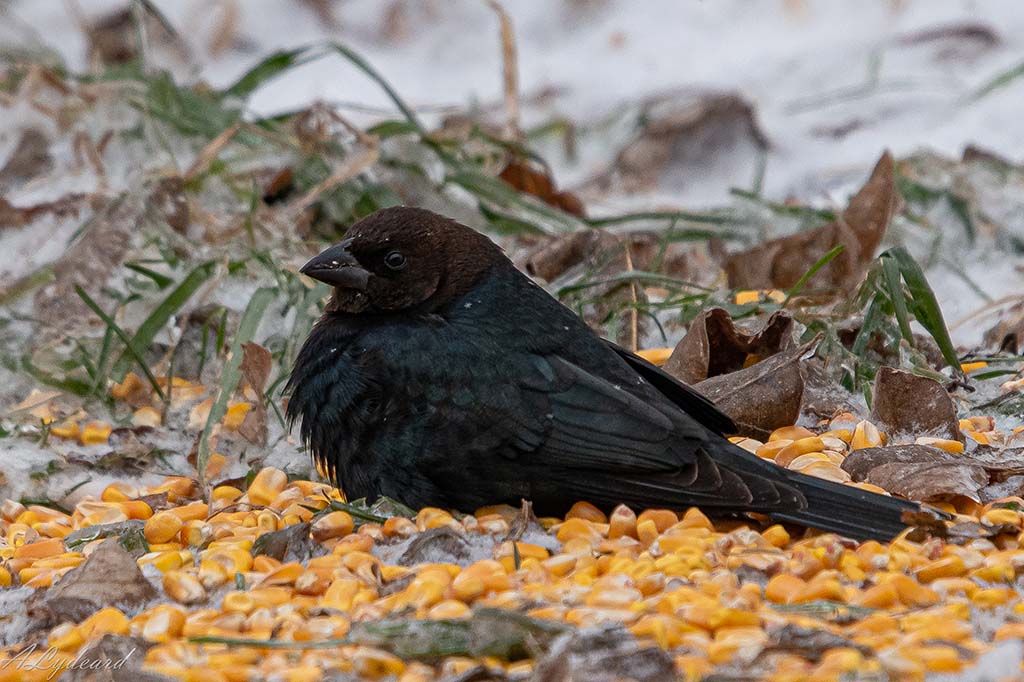
COWBIRDS ARE NEST PARASITES
Q. Do brown-headed cowbirds pick the nest of another bird to lay eggs in based on which kind of bird raised them as a nestling? In other words, if a cowbird is raised as a chick by a red-winged blackbird family, will the adult only target red-winged blackbirds or is it equally likely to invade the nest of a sparrow or warbler?
A. Cowbirds are brood parasites, laying their eggs in the nests of other birds. They themselves neither build nests nor care for their own young. The parents of the invaded nest unwittingly feed the phony foster chick, unaware they are providing food for a different species. At least 120 species of native birds are known to have incubated and fed baby cowbirds to fledging stage, oblivious of the mother cowbird’s sneaky behavior.
How do brown-headed cowbirds select a nest to lay an egg? I asked ornithologist Andrew Lydeard, program coordinator of Alabama Audubon, if research had been conducted to answer that question. According to him, determining how cowbirds pick a nest is mostly hypothetical. The process is “hard to witness, so researchers have to connect the dots on such behaviors.” What is known is that once the female cowbird selects the nest of her host, she lays her parasitic egg about 10 minutes before dawn. Andrew says “they may use the cover of near-darkness to avoid being seen by the host birds, which may have left their nests to forage for themselves before the heat of the day sets in.” With the host birds gone, the female cowbird can quickly lay an egg and leave.
A female cowbird may select a bird nest for her uninvited egg in three ways. During the early breeding season she may choose a high perch from which to watch for nest-building activities by other birds. The cowbird interloper will know “who is building nests and where they are located.” Another approach is to “walk around on the ground looking for activity by ground-nesting species like Kentucky warblers.” The third way is uncommon. A female cowbird will fly into an area where a nest might be. She will “flap and scream erratically, with hopes of flushing out a potential host bird.” This allows her to observe where a nest is for depositing an egg later. Andrew concludes that cowbirds “do not select a host based on their own individual life history but rather out of convenience and the ability to find a suitable, efficient host.” So the answer to the question is that a brown-headed cowbird’s nest choice is highly opportunistic and not preordained based on its own foster parents.
Although a cowbird may seem to have the upper hand against other birds, the odds can shift. Some birds will reject a cowbird egg every time by pushing it out of the nest, whereas others rarely do so. Rejection can come at a cost. Andrew notes that “Mafia behavior” has been reported in which a cowbird will return and “destroy the nest of a bird that has rejected its eggs.” One tough competitor for a cowbird is the yellow warbler, which can sometimes distinguish the large egg of a cowbird from its own small eggs. One of the documented responses of a yellow warbler is to build a new nest when it detects a suspicious egg. But the new nest is not constructed somewhere else. Instead, the warbler builds its new nest on top of the cowbird egg itself, covering it up. The confirmed record so far is of a pair of yellow warblers building six nests, one atop the other, to cover a freshly laid cowbird egg that will never hatch.
Andrew takes a pragmatic approach toward cowbird behavior, viewing it as “a really awesome evolutionary arms race between host and parasite. It’s all about passing your genes on to the next generation, and I’d say they are doing a fine job in that regard.”