SOME ECOLOGICAL QUESTIONS GO UNANSWERED
Q. You reply to a lot of biology questions, sometimes citing scientific publications that have the answer. Have you run across any animal mysteries that do not have a surefire explanation?
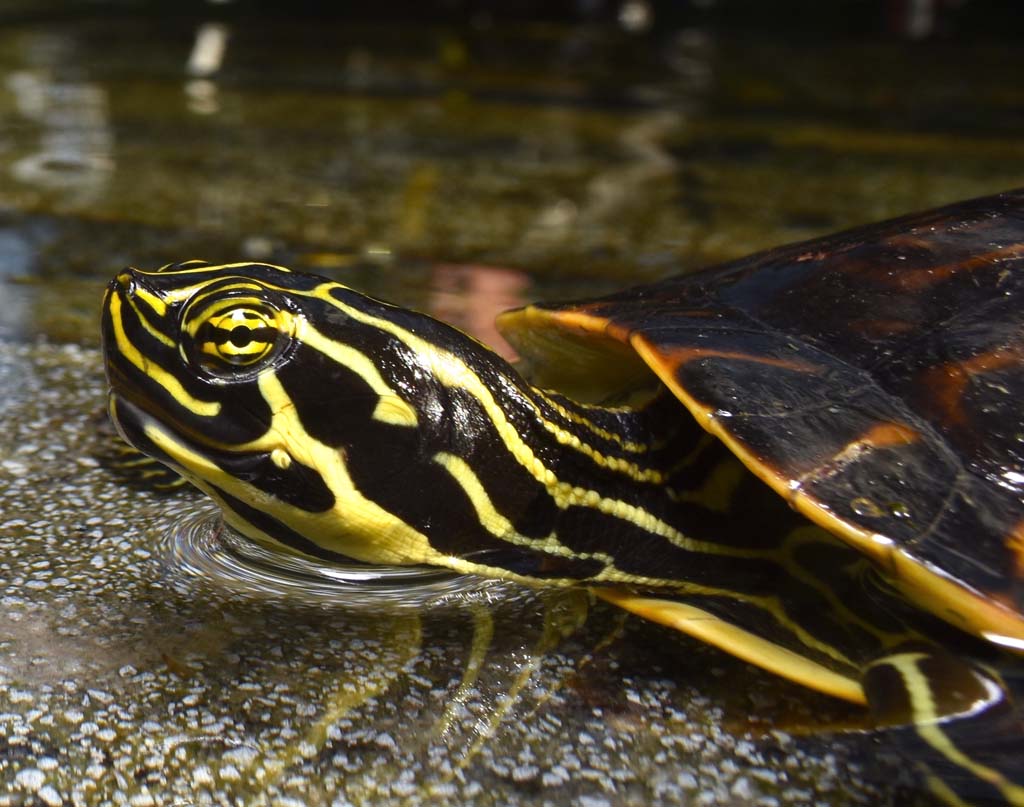
A. Absolutely. In fact, we need not look beyond the eyes of turtles for an example. One yet to be explained feature of some turtles is the presence of a horizontal black bar that runs through the center of a yellow eye. The bar is not for camouflage as it does not always connect with dark coloration outside the eye and does not blend in with the color pattern on the head that would make the turtle less conspicuous.
Raccoons and many other animals have a horizontal black stripe or patch on either side of a dark eye that forms what is known as a disruptive eye mask. Some scientists propose that the combination of black markings straddling a black pupil and iris helps camouflage an animal by diverting attention away from the eye. Not all behavioral ecologists agree that camouflage is the only function of a facial mask, which is found in countless birds and fishes. But the eye bar I am referring to in turtles clearly does not aid in camouflage.
For one thing, the bar stays horizontal, parallel to the ground or surface of the water, not only when the turtle is looking forward but also when its head is tilted to look up or down. The eye bar is found in numerous species of North American turtles and is also present in several unrelated ones from Asia. I am not aware of any study that has unequivocally resolved the function of such an odd morphological structure. One hypothesis is that the bar functions in orientation in some manner to assist turtles that move overland between wetlands.
Two studies at the University of Georgia’s Savannah River Ecology Lab have shown that southeastern yellow-bellied slider turtles (which have the eye bar) can find a wetland up to a mile away through a forested landscape when the open water is not visible. Slider turtles can travel long distances overland but must eventually find a wetland to live in. During a regional drought, the habitat of a population of slider turtles we were studying dried up. The turtles were able to travel unerringly to the nearest body of water, which was several hundred yards away and not visible from the original wetland.
How they accomplished this feat remains undetermined, but a graduate student, Rebecca Yeomans, conducted a remarkable study that confirmed their ability to do so. She released, one at a time, more than 100 slider turtles into a wooded area miles away from where they were captured. The nearest wetland in the forest where she released them was 300 yards away, and a turtle ultimately would need to reach it to survive. In addition Rebecca released the turtles from three different compass directions from the wetland. She attached a spool of thread to the back of each turtle so that it left a trail that she could track, allowing her to determine which direction it went relative to the wetland. A significant number of the turtles oriented in the direction of the wetland, confirming their ability to find water even when released in unfamiliar woods with limited ground visibility. An important finding was that the turtles were much more likely to travel in the direction of the water on sunny days compared to cloudy ones.
Is the horizontal eye bar used in some manner to detect the presence of a distant wetland? Could turtles look skyward and perceive reflected sunlight from a body of water with the aid of the stationary eye bar? Such unanswered questions about animal behavior and the mechanisms they have evolved to survive continue to motivate scientists to uncover mysteries of the universe that are all around us.
Send environmental questions to whitgibbons.com/questions.