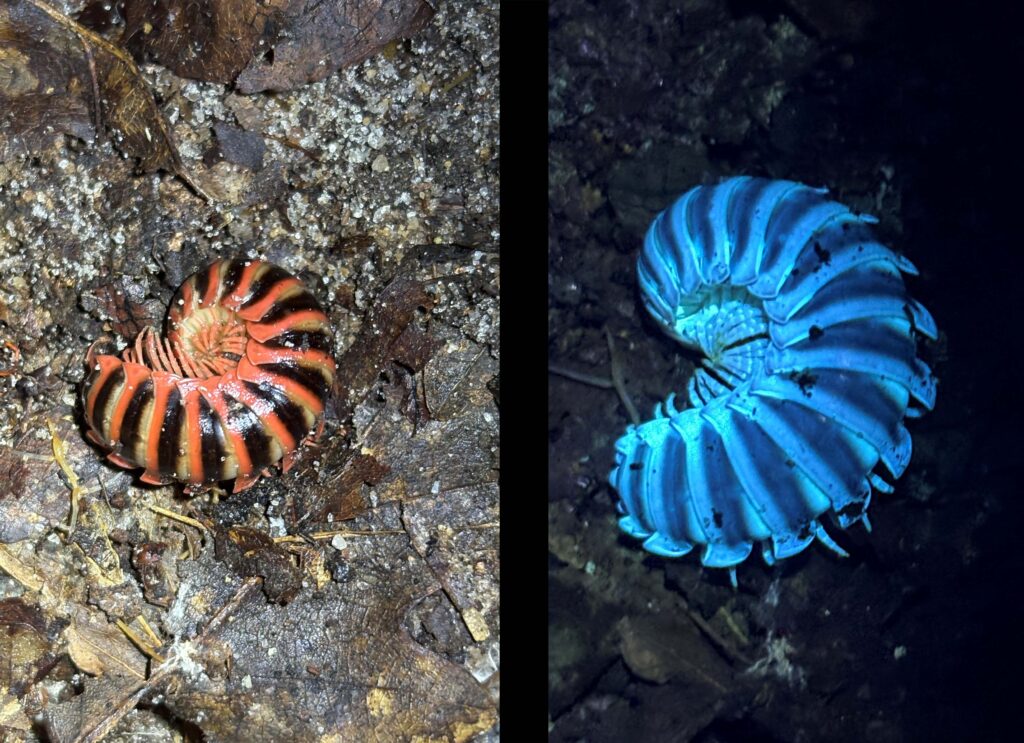
MILLIPEDES GLOW IN THE DARK
At night we saw a vicious predator attacking a much larger prey. In the morning we saw the brightest red blood I have ever seen. We were not anywhere near African big game. A larval insect was the predator, a millipede the prey. The blood was from the circulatory system of another insect. (For those of you taking an entomology class, I realize insect blood is technically called hemolymph.)
We were at Salleyland, 100 acres of what was once worthless abandoned farmland, a rural throwaway site that has revealed what a wealth of hidden biodiversity can be discovered in southeastern woods, swamps and sandhills. I was fortunate to have with me Tess Moody (Clemson Natural Resources Extension Associate), who is an expert on native plants and animals, large and small.
The purpose of the nighttime excursion was to find cherry millipedes, many-legged creatures that roam hardwood forests in search of their primary food source, decaying leaves and other organic material. Millipedes are harmless to humans, in contrast to centipedes, which have venomous pincers. We used regular flashlights at first and then switched to black lights, which give a pale purple light visible to us and produce ultraviolet light (UV) outside the spectrum of what people can see. The reason for using a UV light? The short wavelength UV light invisible to humans reflects off fluorescent molecules and assumes a longer wavelength that we are able to see. Like scorpions in the desert, cherry millipedes fluoresce under ultraviolet light, emitting an eerie blue glow visible 100 feet away. We also found a red russula mushroom in the forest that glowed brilliant blue in the UV light.
We found several glowing millipedes, an extraordinary experience on its own, and picked up one to look at it with a regular flashlight. We both noticed the aromatic smell similar to maraschino cherries produced by a threatened cherry millipede. The chemical defense is comparable to cyanide, making them poisonous to some predators. But Tess noted something I had overlooked. Attached to the millipede’s underside was an insect that was glowing yellow and red in the dark without the aid of lights. The terrestrial, wingless larval glow worm, also known as a railroad worm, was holding on to the millipede, tenacious as a bulldog. The larva is carnivorous, a predator that hunts cherry millipedes at night. We do not know the outcome of this dazzling struggle. Did chemical defense warfare serve its purpose or did the millipede succumb to a vicious predator?
The explanation for why railroad worms light up in the dark and why some scorpions, millipedes and mushrooms glow when you shine a UV light on them is not completely understood, especially since not all do. Whether glowing in response to UV light has a purpose is unknown, although scientists always enjoy speculating. Hypotheses include dispelling or confusing their predators, protecting them from sunlight or serving as some kind of signal during mating season. Or maybe technology has revealed something that serves no purpose. Whatever the biological function of fluorescent properties, if there is one, it has nothing to do with people.
And the blood? I asked Tess the next day what the fluffy white material was on prickly pear plants, a small native cactus, growing in a sandhill habitat. She plucked what looked like a cotton boll from one of them, squeezed it and out came the vibrant red liquid—the blood of scale insects related to aphids. The liquid, carmine, is one of the most extensively used natural red dyes. It was used as far back as the Maya civilization, as well as to make British redcoats in the 1700s.
Thanks to never-ceasing interactions among the biodiversity in any area, intriguing natural phenomena are in progress all around us, both night and day. Take a careful look and see what you can find, even in worthless farmland.
Send environmental questions to ecoviews@gmail.com.