SOME PLANTS CAN BE FASCINATING
Q. Most examples of unusual wildlife are animals. What plants do you think are notable or at least interesting in some way?
A. I have received this question before, the first time being from Joab Thomas, an outstanding botanist from whom I took plant taxonomy at the University of Alabama. His advice about anything with chlorophyll was always worth listening to, and 25 years ago he told me that my Ecoviews columns had too few plant examples. My rationale was that animals tend to be action figures whereas plants are mostly inert unless the wind is blowing. But that is not true of all plants, and since Joab’s admonishment, I have sought to put plants center stage on many occasions. Following are a few plants that deserve their day in the sun.
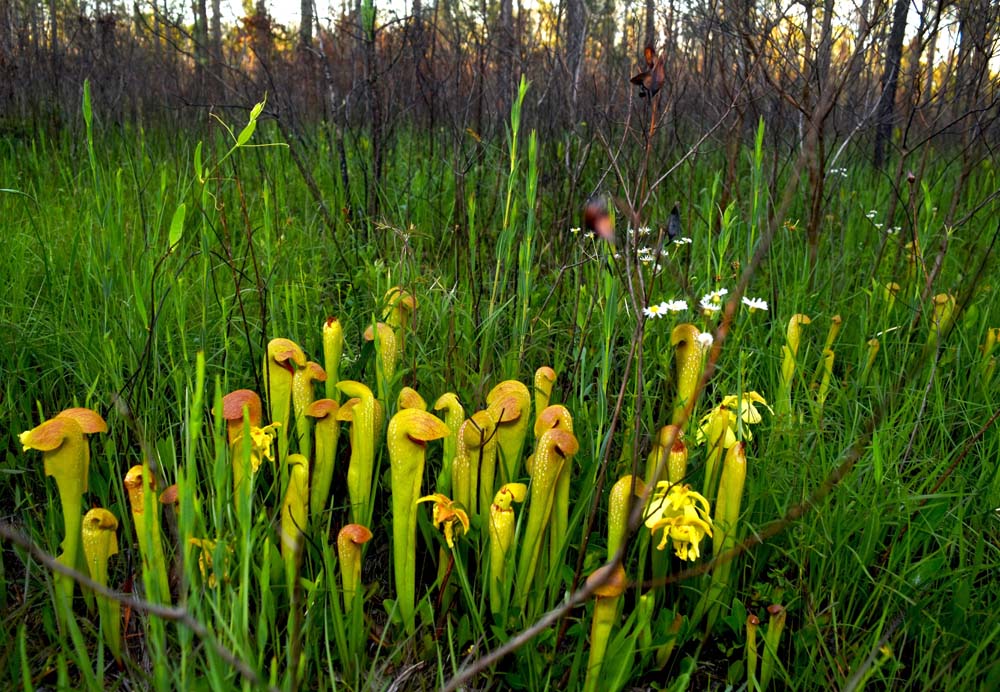
In a sort of man-bites-dog turnabout, throughout the world there are certain species of carnivorous plants that consume more animals than some herbivores eat plants. The vase-shaped pitcher plants operate in a passive but uncompromising manner, digesting hapless insects that venture over the lip of the tube and fall to their death below. Pitcher plants are magnificent in appearance. The yellow (or trumpet) pitcher plants of the southeastern United States can get to be almost 3 feet tall. One of the most spectacular pitcher plants is from Kinabalu National Park in Borneo, a region with the greatest concentration of pitcher plant species in the world. One of these, the rajah pitcher plant, has tubular flasks large enough to capture rats, lizards and an occasional bird. These carnivorous plants hold more than a quart of digestive fluid. Unfortunately, poaching of these awesome giant pitcher plants has been a problem, and few remain in the wild compared to their abundance only a couple of decades ago.
Some carnivorous plants are quintessential examples of plants in action in that they actively attack their prey. Although much smaller than the showy pitcher plant, the Venus flytrap is a lot faster in capturing its victim and does so with more pizzazz. A Venus flytrap has modified leaves that perform a special magic trick for insects. The two halves of the trap look like a large, split butterbean with long spines around the edges. The scent from nectar glands on the inside of the open leaf attracts flies and other insects. When a bug alights and its legs hit the hair triggers, the two halves of the trap slam shut faster than a fly can fly. Now you see it, now you don’t. The flytrap then secretes digestive juices into the chamber, and over the next several hours the insect is absorbed. An impressive bit of chicanery indeed. These unusual little plants are native to only a small region in the Carolinas and unfortunately are threatened by poachers who remove them from the wild.
Bladderworts are probably the most abundant and widespread but least familiar of our carnivorous plants. These small, mostly aquatic plants float at the water’s surface armed with thousands of bladders, special trapping devices about the size of a match head. Their targets are aquatic creatures such as small insects and fish, protozoans, even tadpoles. When the swimmer touches a trigger, a tiny door on the bladder trap snaps inward. The helpless quarry is sucked inside with a rush of water. The door immediately slams shut again, with the creature inside the bladder chamber, and the digestive process begins. The bladderwort door opens and shuts in less than 1/400th of a second, about as fast as plants can do anything. Bladderworts are merciless with mosquito larvae, which squirm around so much they are likely to hit a trigger eventually. The operation occurs at such speed that photographing it has been difficult. For many years botanists did not understand the bladderwort’s process of capturing prey.
Countless other plants have remarkable traits for survival in a mostly animal-eat-plant world beset by climate extremes and other environmental vagaries.
Next week: Century Plants Don’t Live Forever
Send environmental questions to ecoviews@gmail.com.