PEOPLE ASK ABOUT BIRDS, SPIDERS AND EXTINCTION
Q. My wife and I watch grackles each morning when they come to the mealworms in a small flock like a motorcycle gang of thugs. Redbirds, titmice and wrens take a backseat. When a grackle is on the feeder and another lands, both point their beaks upward for a few seconds, almost like a display. Is this a show of submissiveness, dominance or are we just imagining this?
A. I asked Andrew Lydeard, program coordinator of Alabama Audubon. “Yes, from what I know, all our grackle species do this. It’s a peaceful but assertive way to express dominance in the grackle world. The bird that holds that display the longest is usually more dominant. It can also be a signal to nearby grackles as well as other birds. They are definitely sending a message!”
Q. How do spiders build their webs? Some webs stretch several feet from one side to the other. How does the spider span the distance to make connecting points from which to spin its web? Measurement in feet and inches to us must seem like miles to a spider.
A. This is an excellent question for anyone wondering how a spider starts its relatively enormous web that spans a distance dozens or even hundreds of times its body length. I remember asking that question myself some time ago. One scenario is that the spider stands in one place (say, on a limb) and begins releasing a strand of the web material from one of the glands called a spinneret, like we would do with a rod and reel. The strand dangles down, sometime several inches or even feet. A slight wind will move something as light as a strand of spiderweb and take it to the next tree or other vegetation. The strand, which is sticky, adheres to the new position. The spider pulls up the slack and now has a baseline it can scamper across to begin completing the web. Spiders are clever and may have other solutions, but that is one of them.
Q. We are always hearing that this or that animal is on the verge of extinction. Do scientists have records of the last surviving member of a species that went extinct, which presumably would have been in captivity?
A. Yes. Two famous ones are extinct U.S. birds. The official endings for both species occurred at the Cincinnati Zoo in 1914 (a passenger pigeon named Martha) and 1918 (a Carolina parakeet named Incas). They lived only a few feet apart. Whether either species still existed in the wild may be debatable, but these are generally accepted as the last verified records of their species. Each had a distinct appearance and behavior, and both were driven to extinction at a time when humans did not know any better. No doubt records of the last survivor of other species exist in other parts of the world.
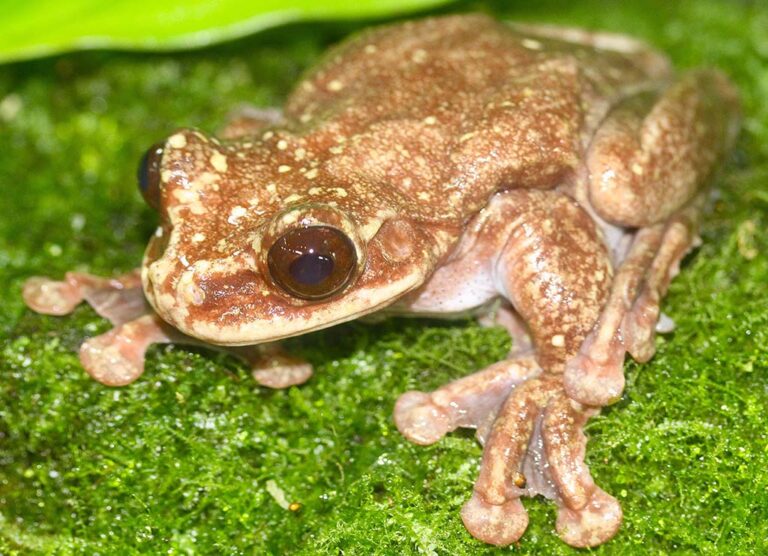
Another example was a bizarre amphibian, Rabb’s fringe-limbed treefrog, from Panama. This unusual frog was believed to be on the brink of extinction in the wild due to an infectious fungus that attacks amphibians. A team of herpetologists led by Joe Mendelson of Zoo Atlanta placed a few individuals in captive breeding facilities where some lasted for years. Unfortunately, none ever produced offspring.
This remarkable treefrog lived in tropical trees high above the ground and had huge toepads on each foot. When threatened, they were known to jump from a limb, spread their legs out and use their toepads and webbing like horizontal sails to glide through the air to another perch. The species has been declared extinct in the wild. All the captive treefrogs are gone too. Larry Wilson of Emory University was able to photograph the last surviving individual of Rabb’s fringe-limbed treefrog before the species disappeared forever. Extinction robs all of us of our natural heritage.
Send environmental questions to ecoviews@gmail.com.