DO BLACK PANTHERS EXIST?
The internet is real. What you find on it may not be. Such as reports that a black panther roams the woods in North America. Over the years I have heard from hunters, bird watchers and research ecologists who claim to have seen such an animal—in Alabama, Georgia, South Carolina and Louisiana. Are the stories true? Do giant black cats exist in North America?
Black panthers of jungle lore certainly exist. Black phases of leopards occur in Asia and rarely in Africa. I saw a captive one once in a zoo, and a majestic creature it was. Black jaguars in tropical America occur in the wild. In rare instances bobcats, which occur in Mexico, southern Canada and most U.S states, can be completely black. Most scientifically verified records are from Florida, but at least one was found in eastern Canada, suggesting that the genetic makeup that causes a bobcat to be black could occur anywhere. The genetic phenomenon known as melanism, which results in an individual being almost completely black, occurs in many mammal species that might otherwise be white, gray, tan or brown. Melanism has been documented in coyotes, gray squirrels and even white-tailed deer, producing almost pure black individuals.
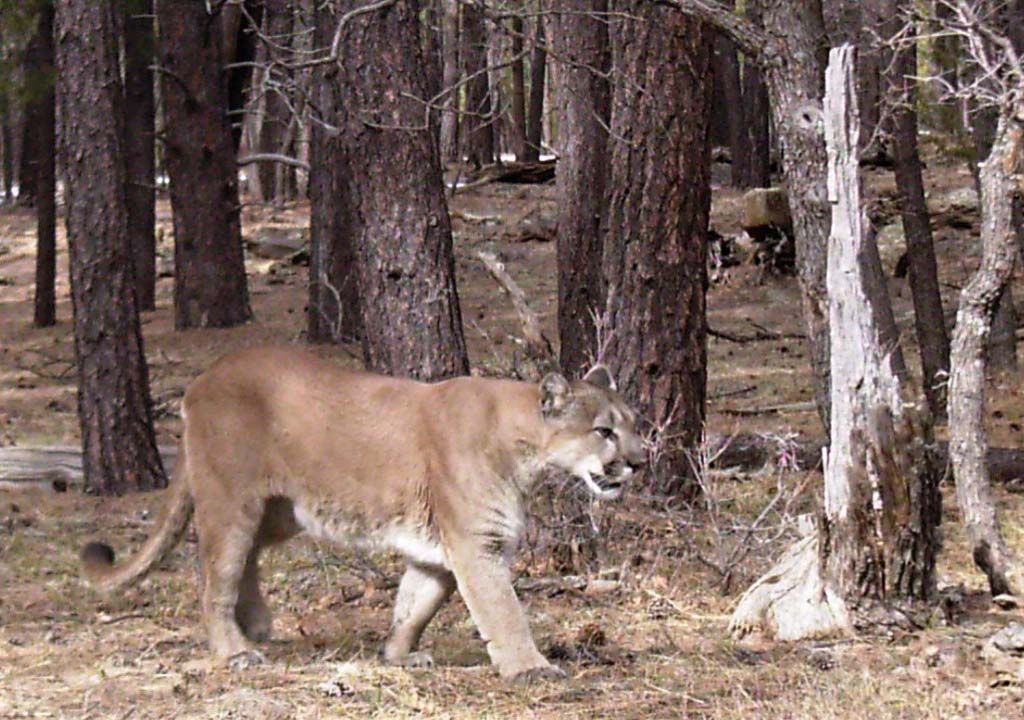
However, when people report seeing a “black panther” in the wild in North America, they usually mean a mountain lion (aka cougar, puma, catamount). No photograph, no carcass, no scientific proof of any sort has ever been provided to indicate that a mountain lion can be solid black. But reports of people seeing black mountain lions abound. One such report in Pennsylvania turned out to be another long-tailed mammal known as a fisher. This does not mean that a melanistic mountain lion does not exist somewhere or did not exist in the past. It only means that the existence of one has not been verified.
I can give several plausible explanations for why someone in the Southeast might claim to have seen a black panther. The first is that the person saw a black bobcat. Confusing a bobcat for a mountain lion may sound far-fetched because bobcats are smaller and have shorter tails, but I know this can happen. I have been called to look at three different road-killed mountain lions, with someone standing looking at it. Each turned out to be a large bobcat. Or a person might mistake a large, long-tailed, dark-colored dog or coyote for a big cat, particularly at night or in fading light. To the embarrassment of two different hunters who made such sightings, the animals left footprints that were made into plaster casts for identification—dog paws both times.
Another possibility exists. Private ownership of unregistered big cats, including leopards, is now illegal in all states, but some continue to exist in captivity. Black ones might be proportionately more common among captive animals than in the wild because of selective breeding. Having a big cat escape from a zoo or a personal holding facility is certainly not unheard of. Such a sighting could be readily validated if the pet owner just spoke up, “Hey, that’s my missing black leopard.” But the owner is more likely to be reluctant to admit to ownership of an enormous, stealthy predator that’s been unleashed on the neighborhood.
Is it possible that at least some people who say they have seen a large, long-tailed black cat in the wild actually saw a black mountain lion? Maybe, but the carcass of one has never been found nor a credible photograph taken. Is it because they are so rare or because they simply do not exist? Black cats are associated with Halloween, which might be a good time to search for a big black cat in the wild. If you do see one, who knows? It might be the first black mountain lion in North America.
Send environmental questions to ecoviews@gmail.com.