ENVIRONMENTAL EDUCATION TALKS CAN OFFER SURPRISES
Having live animals as props is an effective way to get an audience’s attention. When I was at the University of Georgia’s Savannah River Ecology Lab, we used live specimens in our presentations whenever possible, especially when we talked to schoolchildren. We tried to make environmental education entertaining as well as informative for the audience. Sometimes the entertainment and educational elements were unplanned. After all, when you bring wild animals into a grammar school classroom, you should expect the unexpected.
Getting and holding the audience’s attention is essential for a presenter, whatever the subject matter might be. We inadvertently discovered two surefire ways to capture the attention of schoolchildren during an environmental presentation. One is to eat a frog; the other, to have a tortoise attack a third-grader.
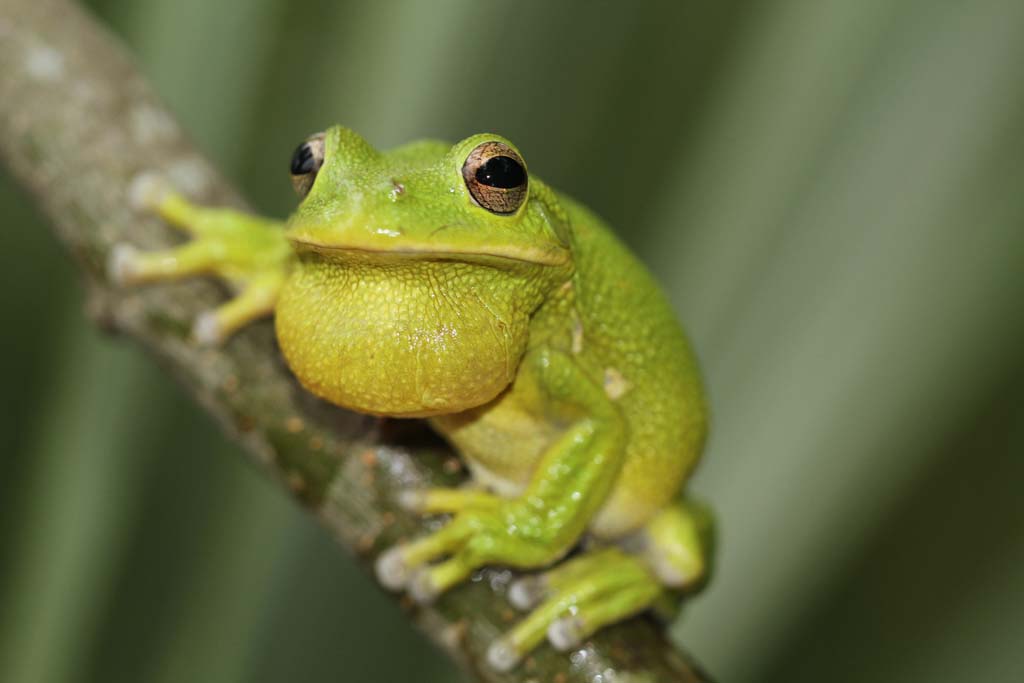
Our colleague Yvonne’s experience with a barking tree frog, our biggest native tree frog, was memorable for everyone. Yvonne was an expert at talking to young children. A handheld frog always grabbed their attention and was a great example of the exciting hidden biodiversity that we seldom see but that still needs to be protected. The big green frogs, which come out at night in warm weather, rely on small wetlands for breeding. Their choruses sound like hoarse dogs barking in the dark.
During a talk, we let tree frogs do a little trick that everyone likes to see—walking straight up the wall using their padded toes. We stress the point that no one but us should touch the frog because they have skin secretions that can be irritating if you touch the frog then rub your eyes, nose or mouth. Yvonne had just provided this last bit of information to a classroom full of first-graders when the frog demonstrated another trick: its ability to jump. In this case, from the wall right into Yvonne’s mouth! For those students, learning about barking tree frogs included the fascinating tidbit that they can make you froth at the mouth. (Fortunately for Yvonne, a restroom was directly across the hall and she was soon able to continue the presentation.)
Turtles don’t climb walls or jump into your mouth, but they make excellent subjects for a class talk. A tactic I liked to use when showing children a gopher tortoise was to offer it a big strawberry. The red color immediately catches the tortoise’s attention, and it will lumber over and eat out of your hand. As herbivores, they eat grass, berries and flowers in the wild. They are a keystone species where they occur, digging deep burrows in sandy soil that are used by the tortoises themselves. In addition the burrows become home for other wildlife as well. Gopher tortoises are a federally threatened species in parts of Alabama and Mississippi, so they are the poster child for talking about charismatic reptiles that need our protection. Also, they virtually never try to bite a person, so during a school talk I like to let one wander around the room.
After feeding a tortoise and leaving it on the auditorium floor where a group of third-graders sat in a semicircle, I turned to get another animal out of a sack. Moments later I heard a commotion and looked up to see children standing, squealing and scattering about. Everyone was pointing in the same direction. One wide-eyed little girl, still sitting, was scooting across the floor backward. The tortoise was advancing toward her with open mouth. Fortunately, tortoises even in high gear are slower than backward-scooting 8-year-olds, so I was able to rescue her from the attack tortoise as it soon became apparent what the problem was. The little girl was wearing bright red shoes, which the tortoise had apparently mistaken for the most luscious strawberries ever imagined.
Educating people about the environment has its surprises—and not all of them are reserved for the audience. I’ll save the incidents with the rattlesnake and the alligator for another column.
Send environmental questions to ecoviews@gmail.com.