PLANTS CAN DISPLAY UNUSUAL TRAITS
Though few plants would make good action videos on a nature show, that doesn’t mean plants are uninteresting. The carnivorous ones are certainly intriguing, whether they capture their prey, usually insects, by passive entrapment like pitcher plants or with fast-moving snap maneuvers like Venus fly traps. Even simple green plants that survive through the process of photosynthesis, using chlorophyll to turn sunlight into sugar, can also be noteworthy.
Voodoo lilies of Southeast Asia are one example: They produce their own heat internally. Temperatures inside a voodoo lily in cool shade can sometimes reach 110 degrees F. The voodoo lily, which has a striking purple flower, reaches a height of almost 3 feet. A garden lover would be captivated by its beauty. However, voodoo lilies have another trait that diminishes their popularity in the garden. During the pollination period, they smell like rotting meat. This smell is the result of the flowers’ ability to heat themselves up.
Pretty flowers and bad-smelling flowers are commonplace. Heat production is generally reserved for members of the animal kingdom, like birds and mammals. What is the explanation for this heat-generating plant? The natural history of voodoo lilies is relatively straightforward and might be guessed by someone with a little biological training. Whenever you ponder the function of an unusual trait in a plant or animal, keep in mind three things: The trait probably enhances feeding, protection or reproduction, the basic essentials needed for an individual to survive and pass on its genes.
The most obvious explanation for the voodoo lily’s thermogenic properties, as they are called, is to attract insects that pollinate the species. Many insects, such as some scarab beetles, seek out decaying meat. The voodoo lily flower produces chemicals with just such a smell. The rise in temperature increases how far the smell travels from the plant, like the aroma wafting from your neighbor’s grill. The farther the better for luring insects to the plant. In addition, warm temperatures inside the flower keep the beetles and other insects in an active state, thus ensuring maximal contact with the reproductive structures of the flower that are essential for pollination.
A native North American plant species with heat‑producing properties is the eastern skunk cabbage. In the Northeast, skunk cabbages are among the earliest plants emerging in the spring, often pushing directly up through a covering of snow that’s been melted by the heat they generate. Some have been reported to raise their temperature 45 degrees higher than their environment. Are skunk cabbages, like the voodoo lily, pollinated by insects that are attracted to a bad smell? Anyone who has trod on a skunk cabbage can attest to the stink and immediately looks around for an annoyed skunk.
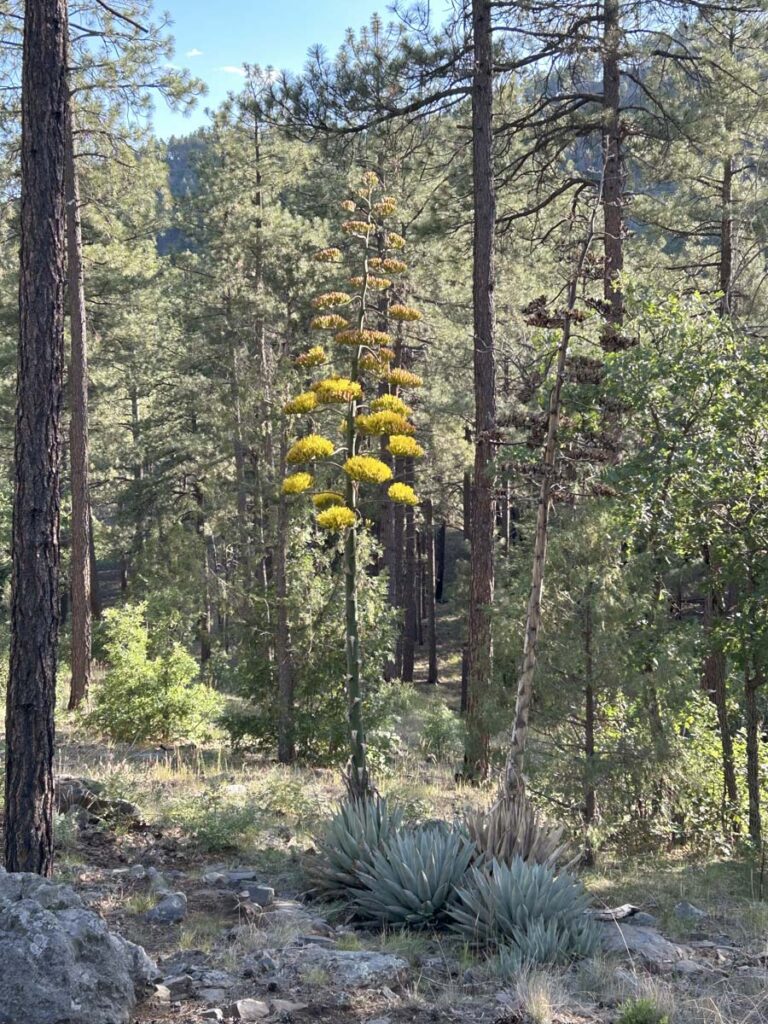
Another group of plants, the agaves, have no need to produce their own heat because they live in hot deserts. One of these I have always found intriguing is the century plant, and I stop to marvel whenever I see one in bloom. Century plants, native to Mexico and the U.S. Southwest, and now sold as horticultural plants in other regions, have a rosette of thick leaves with needle sharp points characteristic of other agave. Rising high above the low-lying plant, the stalk with yellow flowers can be 30 feet high. But a person could become an adult and have their own children before they ever saw the flower of a century plant growing in their front yard during childhood. And if they don’t see it that year, that’s the end of the story, because a century plant only blooms once.
Century plants, voodoo lilies and skunk cabbages are examples of the endless array of lifestyles of plants. Understanding how so many have evolved to have unusual growth forms and life cycles can be informative and inspiring not just to botanists but to anyone who observes the living world around us.
Send environmental questions to ecoviews@gmail.com.