THE SALAMANDER CLUB HAS A REUNION
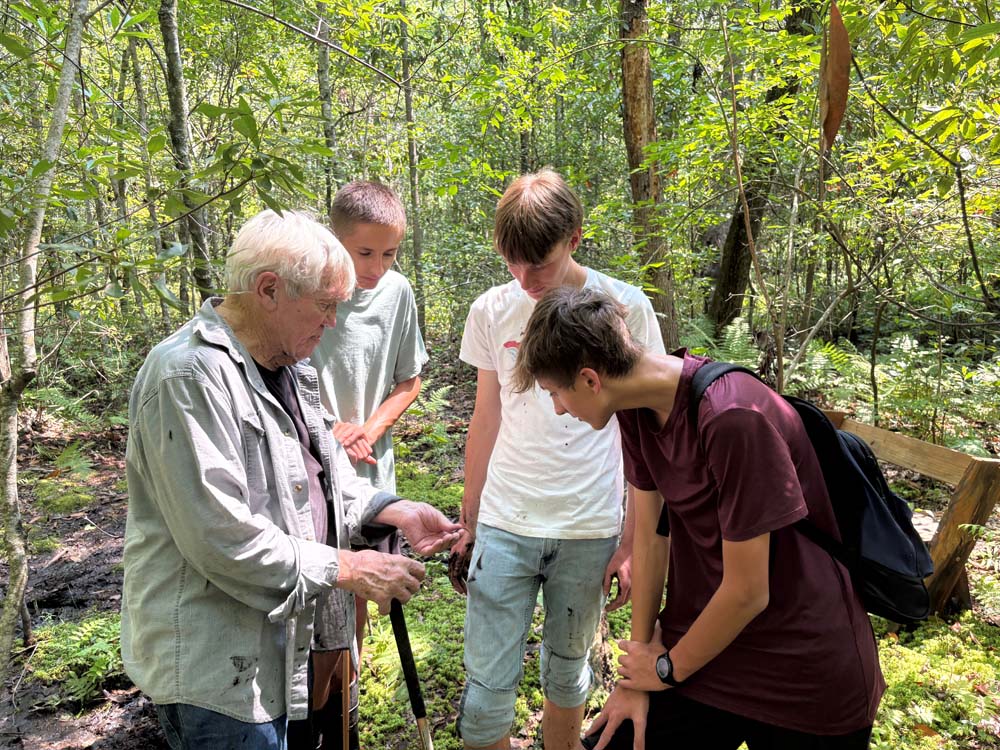
A recent visit to Salleyland, South Carolina, was as pleasant as could be expected on a muggy midsummer day while trudging through swamp mud and wiping spiderwebs from our faces. Even when I mistakenly grabbed a finger-thick green briar vine for support, I dared not complain since I had yet to hear a dispirited word from my companions—Logan, Blake, Nick and Carrie. Instead, everyone stayed focused on our mission—to get deep into the swamp and find a salamander. Why? Because we were having the 7th-year reunion of the Salamander Club.
The inaugural meeting of the Salamander Club, established by twins Logan and Blake, was held at Salleyland when they were 7 years old. I was honored at the time to receive an invitation to become the third member of the club. Shortly thereafter, Nick, who was then 11, easily earned membership status by catching the two salamanders we found in the swamp, especially since they were the first salamanders Logan and Blake had ever seen in the wild. During the reunion trip, Nick retained his membership status by again finding and catching salamanders. A new member, Carrie, showed she qualified for the Salamander Club by getting wet and muddy with no complaints, marveling at the salamanders and serving as wildlife photographer during the trip.
At our first meeting, the twins had shown Nick and me their salamander scrapbook with internet photos of newts and other salamanders. The book contained Logan’s handwritten copy of the Salamander Pledge: “I promise to take care of salamanders at all times.” We all agreed to honor the pledge, as any member would be expected to do. After looking at the scrapbook we discussed the finer points about salamanders, a major group of amphibians in the southeastern United States. According to the book “Salamanders of the Eastern United States” (University of Georgia Press), 138 species inhabit the region, the highest concentration of salamander biodiversity in the world.
We talked about how big salamanders can get. The twins’ scrapbook had a photo of one of the largest in the world, the Japanese giant salamander, which can reach a length of almost 5 feet. We considered what our local salamanders might eat—earthworms, bugs and even smaller salamanders. On the reunion trip, we decided to repeat our swamp adventure from the first time. The five of us set out across the wooden bridge over the creek and began pushing aside tall cinnamon ferns and walking around tupelo gum trees as we sloshed into the sphagnum swamp. The bright green moss forms a mat that is like walking on a wet sponge, and beneath it hide a variety of salamanders. We looked through the sphagnum and turned over soggy logs on the swamp floor in search of salamanders, snakes and frogs. We found all of them, and everyone got to hold a handsome ringneck snake.
We succeeded in finding our target animals, salamanders: two species, including a colorful yellow one with black stripes (a 3-lined salamander) and a red eastern mud salamander that tried to escape down a crawfish hole. The reunion was a success. We passed the specimens around and then released each where we found it. We spent the rest of our time marveling at and learning about the vast array of plants, birds and countless smaller animals like crawfish and leeches whose world we had entered.
As I indicated during our first trip to find salamanders years ago, the twins’ enthusiasm for being outdoors “in the wild” sends an environmental message to parents of young children. They would not have such an adventurous spirit, looking for animals and plants in their natural habitats, were it not for parental encouragement. Kudos to their parents and to all like them. Developing a conservation ethic begins with instilling in children a fascination with the natural world.
I still hold true to the Salamander Club Pledge, as anyone interested in the natural world and native species should.
Send environmental questions to ecoviews@gmail.com.