WHAT IS THE ORIGIN OF CORKSCREW BURROWS?
Extraterrestrial aliens have been given as an unscientific explanation for a variety of engineering marvels, including the Egyptian pyramids, Easter Island statues and Stonehenge. Little green men with shovels might also have been some folks’ explanation of a natural phenomenon in Australia and Nebraska.
During the last quarter of a billion years or so, a variety of vertebrate animals have excavated deep, spiral-shaped burrows in the ground. Some of them went several feet straight down in a helix. Early paleontologists called them “devil’s corkscrews” and spent many years speculating on the origin and purpose of these burrows. The earliest scientific reports are from the 1890s. As often happens with new discoveries, these odd constructions that had no modern counterpart prompted various explanations. Almost a century after their discovery, spiral burrows in Nebraska were reported to have been made by an extinct beaver.
Lots of animals living today, including ants, mice and prairie dogs, burrow into the ground. Almost every turtle in the world digs a nest in sand or dirt to lay its eggs. According to Bob Zappalorti, executive director of Herpetological Associates, Inc., pine snakes living in sandy habitats in New Jersey dig horizontal tunnels more than 6 feet long to make a chamber for laying their eggs. Gopher tortoises of the Southeast are noted for their underground burrows that often extend more than 20 feet horizontally. But the purpose of the enigmatic corkscrew tunnels of long ago kept scientists bewildered for decades, in part because no modern equivalent existed. But thanks to studies by Sean Doody (University of South Florida) scientists now know of an animal living today that digs a spiral staircase beneath the desert: a giant Australian lizard.
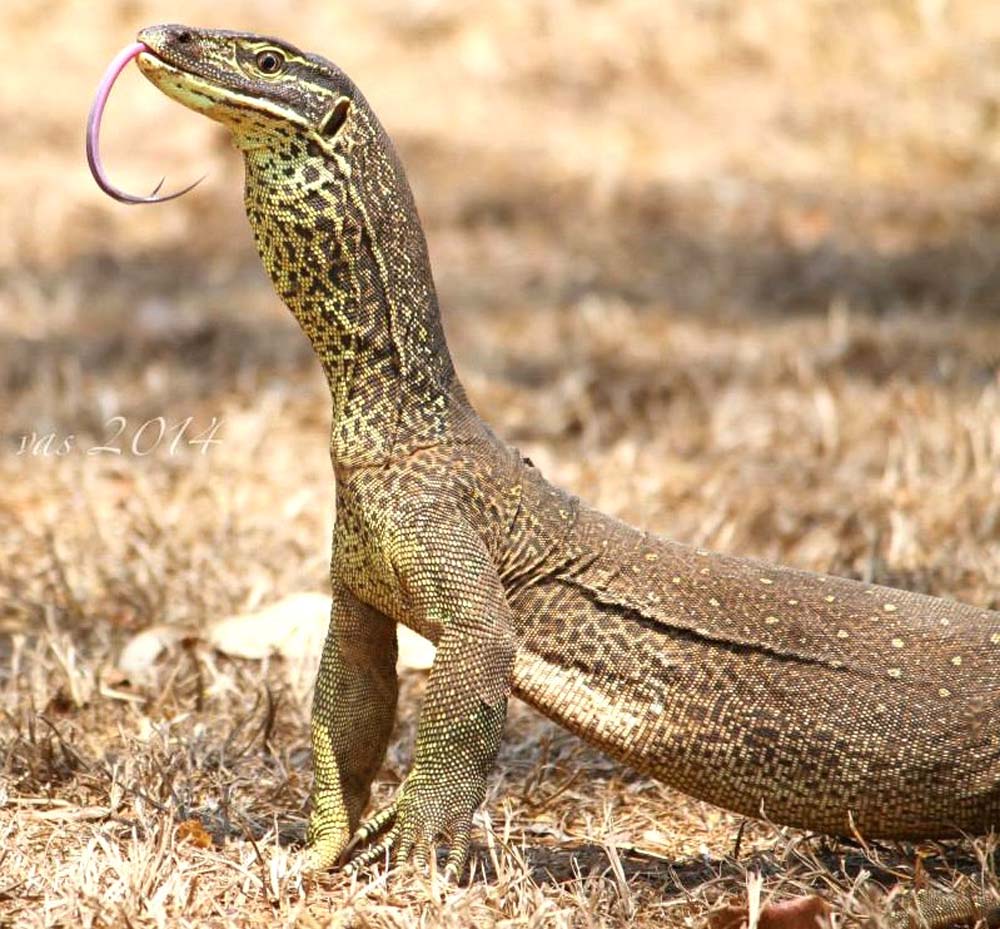
Sean has studied the ecology and behavior of yellow-spotted monitors in Western Australia. These enormous lizards, which are related to Komodo dragons, reach lengths of more than 5 feet. I remember seeing one in northern Australia standing on its back legs and supported tripod-like by its tail. It was looking through a window at customers in a restaurant that also had outdoor seating. I decided to eat inside. Sean showed me photographs of what looked like an archeological dig. He and his colleagues used shovels to carefully excavate a large area, several yards on each side and above their heads, to investigate the nesting habits of the big lizards.
Sean and his crew were rewarded for their meticulous quarrying efforts by discovering corkscrew-shaped tunnels going straight down below the desert floor. At the bottom, they found a nesting chamber. They excavated and measured 52 of these spiral tunnels, which were capped at the top, preventing the entry of would-be predators. According to their paper in a journal of the Linnean Society they are the “deepest known of any vertebrate, and by far the deepest of any reptile.” The deepest burrows went down for more than 11 feet, like spiral steps in a lighthouse.
The research team concluded that egg survival is the explanation for the unusual architecture. The lizards nest in a region and during a season of near perpetual drought. Egg incubation of yellow-spotted monitors takes 8 months. Desiccation is a serious threat to eggs in such an environment, and a deep nest chamber solves that problem. Also, upon hatching, the young lizards can make their way to the surface without being buried alive or expending energy digging out.
The researchers concluded that the mystery of the ancient corkscrews discovered more than a century ago has been solved. Devil’s corkscrews “were used mainly for nesting or rearing young, because helical burrows of extant vertebrates are generally associated with a nest.” Imagine the time and effort needed for an animal to dig a long spiraling tunnel deep into the ground. Another of Mother Nature’s wonders. Imagine, too, the training, skill and dedication of scientists like Sean Doody and colleagues who help solve the mysteries of the natural world.
Send environmental questions to ecoviews@gmail.com.