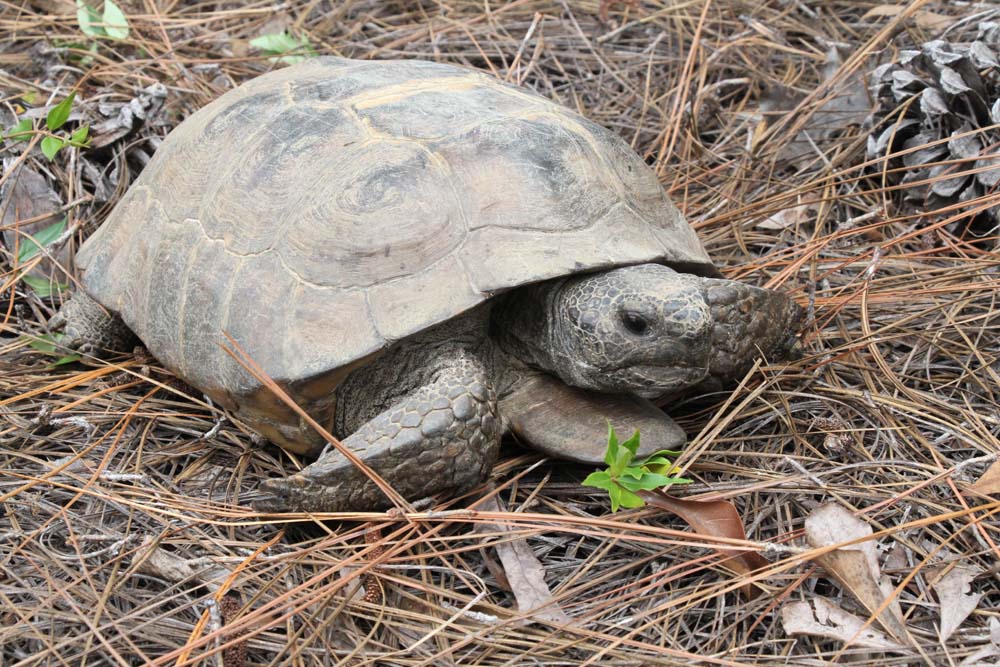
TORTOISES COME IN ALL SIZES
What do you think of when you hear the word “tortoise”? The giant tortoises that lumber along like tanks over the Galapagos Islands in the Pacific and the Seychelles in the Indian Ocean? The gopher tortoises of the Southeast that dig long underground burrows to which they retreat for safety? The endangered desert tortoises of the Southwest? According to research biologist Jeff Lovich, coauthor with me of “Turtles of the World” (Princeton University Press), female desert tortoises eat rocks and soils, presumably to obtain calcium for egg production. These represent only a few of the 65 species of terrestrial turtles we call tortoises. To fully appreciate the diversity of tortoises on a global scale, consider these lesser-known examples with special attributes of their own.
In addition to inhabiting oceanic island complexes of the Galapagos and Seychelles, tortoises are native to North and South America, Europe, Africa and Asia. Australia’s reputation as a home for bizarre animals doesn’t extend to tortoises. No tortoises of any kind are found there. Several African tortoises, not as well known as the bulky American ones or the giants of the island complexes, are intriguing in their own right. Morphological or behavioral traits qualify some as unique.
Among the world’s tiniest species of tortoises are the padlopers. One from South Africa is referred to as the “world’s smallest tortoise.” Most adults reach a shell length of less than 4 inches. Africa is home to not only the smallest but also the largest tortoise found on the mainland of any continent. The spurred tortoise, also called the sulcata, can weigh more than 200 pounds. Spurred tortoises are native to the territory south of the Sahara across northern Africa.
One group, the African tent tortoises, are beautiful. Their high-domed black shells with bright yellow geometric designs are a colorful example of Mother Nature’s art. They are among the few turtles to be preyed upon by ostriches. These are small tortoises, reaching lengths only slightly larger than the familiar eastern box turtle. Box turtles are terrestrial, but they are not tortoises. They belong to a family of mostly aquatic turtles found from Canada to South America.
One notable anatomical trait of box turtles is a hinge on their bottom shell that allows them to close up completely so that their head and limbs are protected, tightly encased in a hard shell. That feature is present in several turtle species. The hinge-back tortoise of Africa also has a hinge mechanism, but one found in no other turtle in the world—the hinge is on the back of the shell instead of the bottom. The males of the African padloper tortoises are distinctive in changing color during the breeding season. The front part of the face turns orange.
One of my favorites is the pancake tortoise of East Africa. These little tykes live in rugged terrain with lots of rock crevices. Their shell is flatter and the plates thinner and more flexible than any other tortoise on earth. Being stepped on by large hoofed mammals is one of their natural threats. When they feel the vibrations of an approaching herd, they quickly run to a rock crevice and wedge themselves in. This behavior also helps them escape predators that are unable to dislodge them. The leopard tortoise of East Africa and South Africa has a striking appearance, with juveniles and young adults living up to their name by having dark spots on a yellow shell. They are found in mountainous elevations above 9,000 feet, higher than most other turtles globally.
One unfortunate aspect of African tortoises, one they have in common with turtles worldwide, is that their numbers in the wild have been dramatically decreased. The decline for some is nearing extinction in the wild. Illegal poaching for the pet trade is a common threat for many. Unregulated land development is an ongoing problem. Unless these two problems are brought under control, we could lose some fascinating creatures—forever.
Send environmental questions to ecoviews@gmail.com.