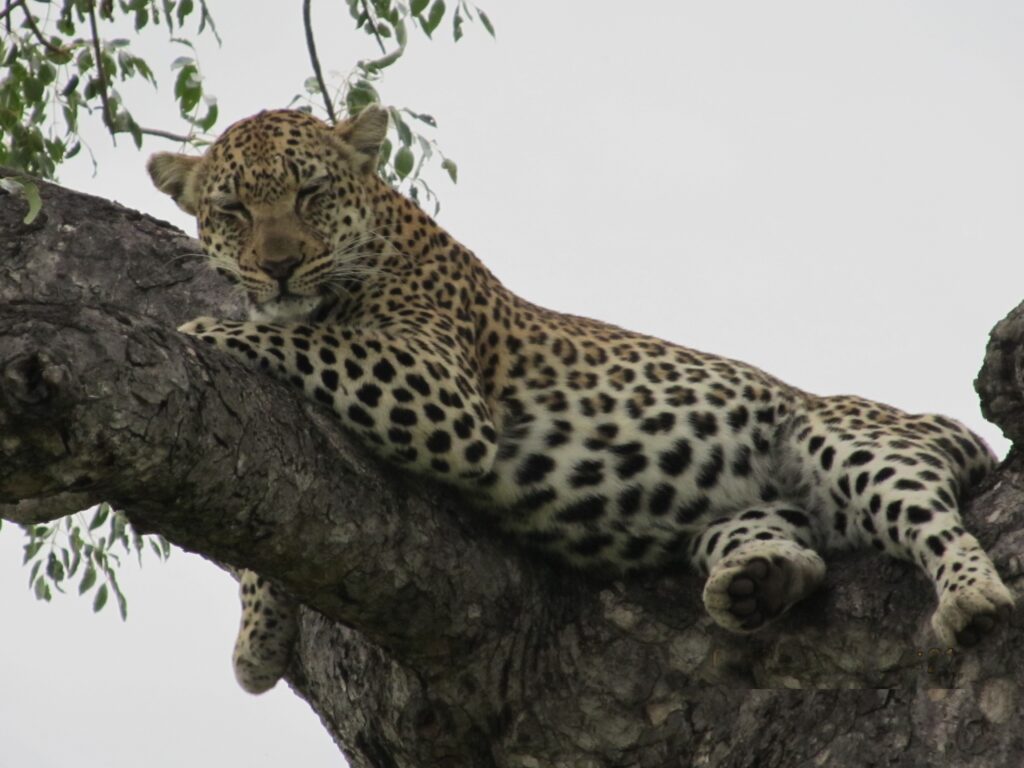
THE LEOPARD IS THE PRINCE OF PREDATORS
The leopard, the most graceful of Africa’s predators, is feared throughout the continent. Leopards do not consider humans to be special, aside from their being easy prey that neither bite nor scratch and can’t even run fast because they only have two legs.
Leopards usually ignore people who remain quietly inside an open safari vehicle. I owe some close-up shots of leopards from just such a vehicle to Frank Watts, an outstanding South Africa safari guide. Frank refers to the leopard as the “celebrity of Africa” because of its graceful demeanor and unrivaled elegance. If the beasts of Africa held a contest to select a runway model, the leopard would be the uncontested winner.
Frank’s extensive knowledge of the ecology and behavior of animals in the African bush led to many educational insights. Upon my noting that a troop of chacma baboons we were watching had fascinating social behavior but also some unsavory physical habits, he asserted that “baboons will challenge your love of animals.” If we happened to encounter a lion while we were on foot, he advised us “not to run because it changes your status.” Regarding the African buffalo, one of the primary killers of lions (and people on foot), Frank said, “A buffalo looks at you like you owe him money.”
Frank Watts has also written a book, “The Other Animals of the Kruger National Park.” In it he recounts some of his many adventures—with animals and with people (the “other animals” of the title). He notes that during his 17 years at Kruger “six of my friends and colleagues [were] killed” by leopards, “the prince of predators.” One even jumped into an open safari vehicle and mauled the guide. I learned of that incident only after I had taken my own photos of wild leopards from an open safari vehicle 10 feet away. I think those pictures will have to suffice.
In one story Frank tells of taking a couple on a weeklong safari in which they encountered virtually all the large animals found there, except one—the leopard. The couple told Frank they had come to South Africa many times but had never seen a wild leopard. Their last few visits to the country had been for the sole purpose of seeing one. Frank Watts would clearly be a good choice of guides for achieving that goal. But during the week, no luck.
The couple was to leave early the next morning. Late that night Frank heard the “sawing” of a leopard, “the deep-throated sound [that is] unmistakable to those who know it.” Loading the couple into a safari vehicle, Frank left the safety of the camp compound, where tall electric fences protect visitors from outside predators, to pursue the long-awaited sighting. They found it, watched it, listened to it growl and watched it some more. Satisfied after a quest of many years, the couple were ready to start back. To their dismay, when Frank turned the key in the ignition, the motor would not start. After several terrifying minutes sitting in an open vehicle with a big cat lying a few feet away in the surrounding darkness, Frank made a decision. With only a small flashlight to light his way, he walked back to the camp. There, he got another vehicle and returned to where the couple were waiting. Fortunately, they were unharmed, and the adventure had a happy ending. But as Frank says, “It was the longest 300-meter journey in history.”
Frank Watts was also the safari guide when a National Geographic crew filmed a life-and-death struggle between three of the continent’s most ferocious beasts—African buffalo, lions and crocodiles. The remarkable footage simultaneously depicts “nature, red in tooth and claw” and the power of parental care and social cohesion. If you are not squeamish, watch the “Battle at Kruger” www.youtube.com/watch?v=LU8DDYz68kM. And if you go to South Africa, get Frank for your safari guide. Maybe you’ll get to see a leopard.
Send environmental questions to ecoviews@gmail.com.