NATURE TALKS GONE AWRY CAN BE MEMORABLE
Environmental education may be more important these days than it has been in decades. Some ecologists, including me, have elected to deliver the message through public talks about the wonders of natural history and animal behavior. But as the saying goes, “No matter how many talks you give, one will be your best and one will be your worst.”
I recently reflected on presentations I have given that might be contenders for a Worst Talk award. I dismissed talks that were simply lackluster and just had not clicked for one reason or another, such as my not bringing a live snake. But two presentations came to mind that, at the time, seemed to qualify as candidates for Worst Talk Ever. They have since evolved into treasured memories.
I am not likely to forget my banquet talk to state science fair contestants in Arkansas. I had color slides (this was a very long time ago, Gen Zs) and had prepared a logical and orderly talk about native wildlife. As I was being introduced, a student handed my tray of 80 slides to the projectionist. Actually, he started to hand them over but tripped over an electrical cord and dropped the tray. Slides went everywhere.
Reorganizing a slide presentation while 200 restless teenagers watched was not really an option. Telling the clumsy student I would see that he never got to play football in the state of Arkansas seemed pointless. Instead, concealing my despair, I asked the projectionist to fill in the slots with slides any which way and we would see what came up. Field ecology, I told the students, was exciting because you never knew what you might find. We would introduce a bit of real-life unpredictability into this presentation.
These kids had been listening to two days of scientific presentations. Sitting through yet another one was not their idea of a fun way to spend Friday night. But when the first slide was an upside-down bullfrog, they perked up. When the next one was an inverted word slide of my conclusions, they had fun trying to read what it said. An inside-out map of Arkansas was for some reason hilarious, and ad-libbing became easy with such an amused and involved audience. I don’t know how much they learned about ecology, but they certainly learned that sometimes you should embrace the unexpected.
Another memorable talk was to a group in Jacksonville, Fla., who had brought their pet snakes for a trading session after the program. They met in the city museum, and I was to give the talk in the planetarium, the only room available that night. The planetarium operator, however, couldn’t make the meeting and had given the keys to someone else.
Surprise. Not everyone knows how to turn on the lights in a planetarium. Someone finally managed to turn on sidelights that encircled the room—all red. Someone else figured out how to get the slide projector operating—on the curved ceiling. Nothing else was operable and the crowd was getting restless as planets swirled above through a starry background.
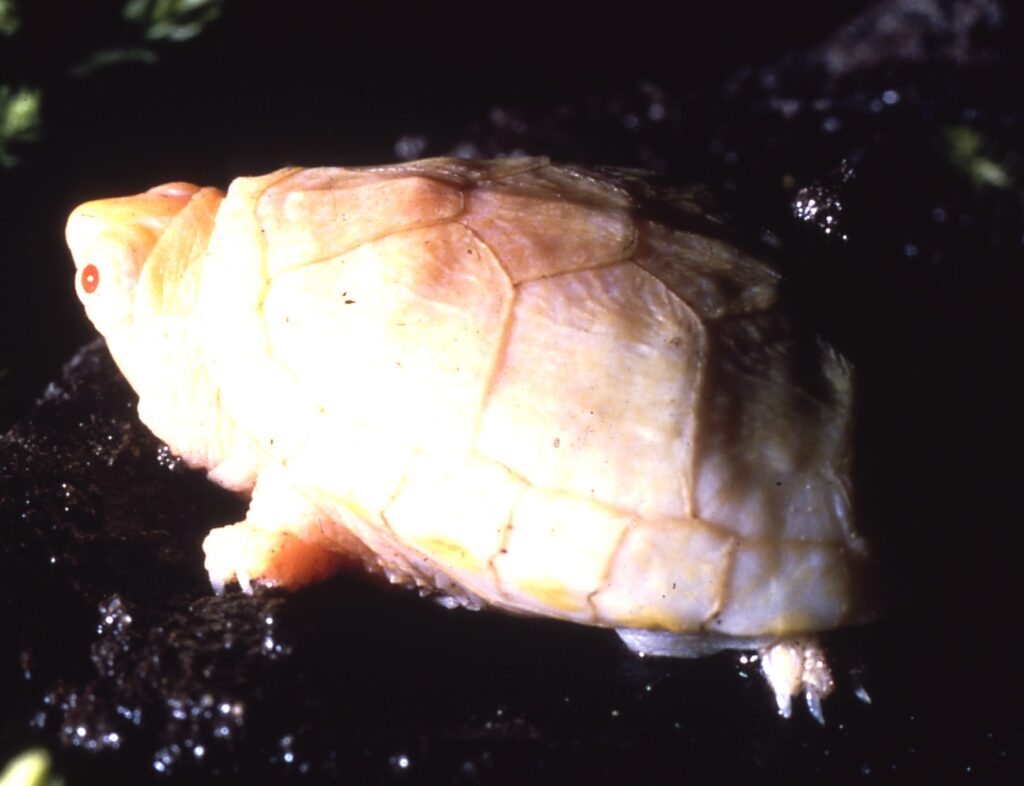
I was introduced at the podium in the glare of a red spotlight to an audience bathed in red light. I felt like I should be wearing an Elvis suit or hawking products that are almost certainly illegal in Florida. Undaunted, I clicked on the first slide and began my presentation. The planets disappeared, and a baby albino turtle’s image appeared on the ceiling the size of Godzilla. I knew this would be a talk to remember.
The seats were tilted so people could only watch the ceiling. No one was able to see me at the podium, lecturing in the eerie glow of the red spotlight. When the presentation was finally over, audience members climbed out of their recliners and began to pull snakes out of bags to trade while I took a last look around at the red-tinted people and slipped out a side door.
Send environmental questions to ecoviews@gmail.com.