WHAT ANIMALS HUNT IN PACKS?
Q. Most folks know that lions and wolves hunt in groups to catch what they’re going to eat. I was wondering if any other animals hunt in packs or team up to catch their food, not counting the velociraptors in Jurassic Park.
A. Cooperative hunting may be more common than most people realize. As you note, wolves and lions cooperate to capture prey. But another group of cooperative hunters comes to mind immediately. Ants. Army ants and fire ants are noted for swarming and killing prey. Many other ant species do the same.
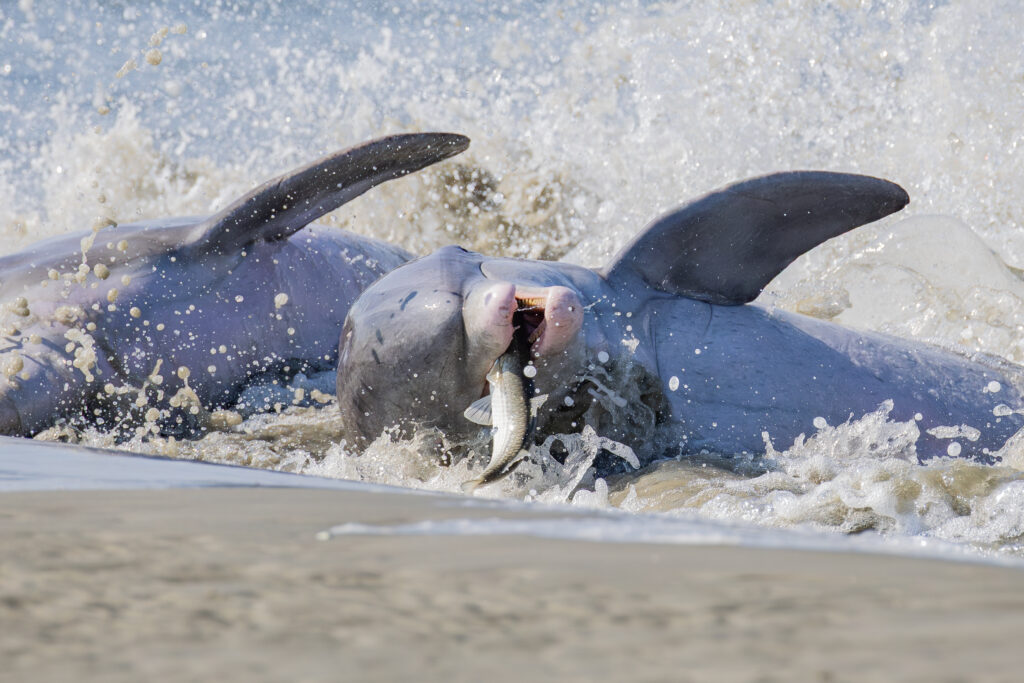
Many folks in southern coastal areas know about strand feeding, the remarkable fish-catching behavior demonstrated by bottlenose dolphins. A pod of dolphins will corral a school of fish, propelling them toward shore. When the fish jump out of the water to escape, the dolphins do belly slides and end up amid the fish, eating those flopping around. Humpback whales have an unusual form of prey capture known as bubble netting. As many as two dozen whales swim together in a circle deep below the ocean’s surface while blowing bubbles. The rising air forms a cylinder of bubbles through which the thousands of fish inside cannot pass. The trapped fish make easy pickings for the whales swimming up through the bubble net with open mouths.
I once saw a dramatic confrontation between two mammal species, each with cooperative hunting behavior—spotted hyenas and African wild dogs. I was watching a wild dog pack chase a herd of impalas when I looked behind the dogs and saw several hyenas gaining on them. Hyenas will follow wild dogs that are chasing prey then move in after the kill, robbing the dogs of their prize. African wild dogs, however, behave like a superorganism. Several of the dogs turned and formed a group. Then, as if a leader had said Charge! away they went headlong toward the hyenas. A hyena can beat a dog one-on-one but not a dog pack working in unison. The hyenas dispersed, choosing not to take on this well-trained platoon. The dogs returned to a meal of fresh impala.
What about vertebrates other than mammals? Harris’s hawks in the southwestern United States have been well-documented to work together to catch rabbits or other terrestrial prey. As far as I know, these western raptors are the only birds of prey in the world to have been scientifically documented to hunt in packs. Harris’s hawks are a relatively common bird of prey from Texas to the Arizona deserts. Their geographic range extends thousands of miles farther south to Chile. As many as a half dozen Harris’s hawks hunt together, singling out and surrounding an escaping mammal. Visions of these aerial wolfpacks probably give jackrabbits nightmares.
Cooperative predation by birds was documented convincingly for the first time in 1988 by James C. Bednarz in Science magazine. According to the author, “Individuals coordinate actions such that the probability of successful capture of one large prey item [to be] shared among all participants is increased.” Bednarz’s study was impressive. He used radiotelemetered hawks to follow their behavior in a New Mexico desert. The raptors were unquestionably working as an organized unit to track their prey. He noted that cooperative hunting “has been reported almost exclusively for social mammalian carnivores.”
Clearly, some animals have developed highly effective cooperative hunting actions.
And the behavior may be more common among other animals, including birds, than we are aware. Perhaps such behavior has simply not yet been observed. The phenomenon should of course be familiar to all of us: The deadliest and most cooperative hunters in the world are humans.
Incidentally, the view of many paleontologists, perhaps even most, is that velociraptors were not organized packs of hunters but simply ended up chewing on the same fallen dinosaur, the way a bunch of vultures would eat a dead deer. But who knows exactly how predators caught prey 70 million years ago?
Send environmental questions to ecoviews@gmail.com.